Originally published on AI-Native, Deeply Human on Substack.
Watch on YouTube: 67% of AI Adoption Blockers Are Organizational, Not Individual
Microsoft’s 2026 Work Trend Index analysed trillions of anonymised Microsoft 365 productivity signals and surveyed 20,000 AI-using knowledge workers across ten markets. One finding should reframe how every executive reads their own AI dashboard.
Organizational factors — culture, manager support, talent practices — account for 67% of the reported AI impact in that survey, against 32% for individual factors such as mindset and behaviour. More than twice the weight sits in the environment around the worker, not in the worker.
Be careful with the number. It is an association in self-reported survey responses, not a causal effect, and it describes the organizational factors behind the AI impact people reported — not the share of adoption blockers. The model is a random forest over 29 predictors, normalized so the top factor equals 100, and the ranking holds across three model families with test R² between 0.68 and 0.69. A robust correlation is still a correlation. Read it as an instruction to look at your system, not as proof that you have found your cause.
The strongest correlates are specific enough to act on: a culture that encourages experimentation, managers who model AI use and reward it, and talent practices that reflect AI in how people are evaluated and developed.
We strapped jet engines to horse-drawn carriages
Here is the image I keep coming back to. We strapped jet engines to horse-drawn carriages — then acted surprised when the carriage shook itself apart.
The failure is well documented now, and it is not the engine. MIT’s NANDA study, The GenAI Divide, found that 95% of enterprise generative AI pilots produced no measurable impact on profit and loss, against roughly $35–40 billion invested. The authors named the cause a "learning gap" between the capability of the tools and the workflows they were dropped into — explicitly not model quality. Capgemini had found 88% of AI pilots stalling before production; S&P Global found 42% abandoned outright.
Microsoft’s own data makes the same point from the other side. AI capability is only one part of a working system. Model errors, unclear ownership, fragmented data and slow approvals can each limit results, and training alone leaves people frustrated when they still lack permission, usable data or time to apply what they learn.
The Transformation Paradox
The report names the collision precisely, and it deserves a wide audience. 65% of AI users fear falling behind if they don’t adapt quickly. Yet 45% say it feels safer to focus on current goals than to redesign work with AI. And only 13% say they are rewarded for reinventing how they work even when results are missed.
Sit with that last number. Thirteen percent. The organization asks for transformation and pays for continuity. People read the incentives correctly, every time. Microsoft calls this the Transformation Paradox: the same forces accelerating AI adoption are the ones holding it back.
Independent surveys agree on the ordering. McKinsey’s State of Organizations 2026 survey (n=10,018) found the top barriers to scaling AI were concerns about AI itself — bias, intellectual property, job replacement — at 46%, regulatory and legal concerns at 44%, and organizational challenges such as change management and silos at 39%, ahead of technology infrastructure at 31% and financial constraints at 27%. Capability and capital are not the binding constraints. The conditions around the work are.
Microsoft’s own segmentation shows what that costs. Roughly one in five workers sit in the Frontier zone, where individual capability and organizational readiness reinforce each other. About one in ten are blocked: skilled people inside organizations that have not caught up. Around half sit in between. And only one in four AI users say their leadership is clearly and consistently aligned on AI.
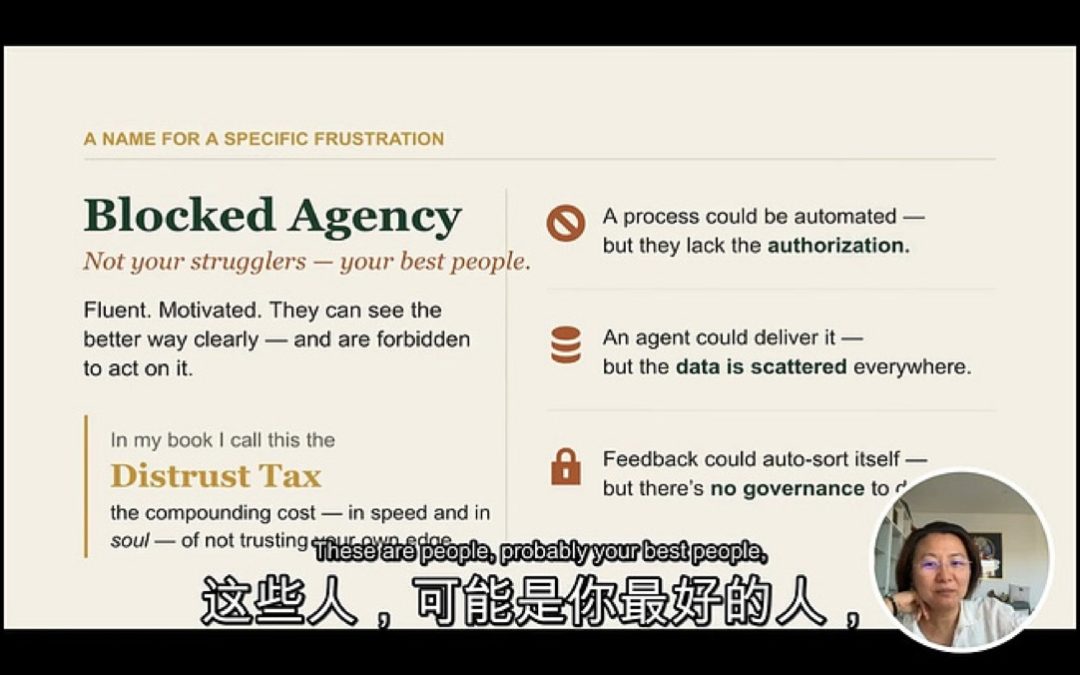
Blocked agency
The report gives the failure a name I find precise: blocked agency. Capable people, trapped by permissions they cannot get, data they cannot reach, and processes nobody can explain. They can see the better way to work. They cannot get there from where they are standing.
The economics of that gap are now visible. McKinsey’s 2026 State of AI survey (1,719 respondents across 97 countries) found 89% of organizations using AI in at least one business function, and 80% of individuals reporting better personal productivity — while the share reporting any EBIT impact stayed flat at 37%, and only about 6% qualify as high performers. Adoption is nearly universal. Impact is not.
The behaviour that separates the winners is narrow and specific. Among companies generating significant financial results from AI, nearly three-quarters have fundamentally redesigned their workflows, against roughly a quarter of everyone else — and they are 3.3 times more likely to treat AI as business transformation rather than a tool rollout. As the McKinsey Global Institute put it: "The tools are here. But the reorganization is not."
The manager is the hinge
Microsoft’s companion People Science study of 1,800 employees — including 819 leaders, 520 managers and 461 individual contributors — looked at how the manager role is changing in AI-first organizations. The organizational factors that correlate most strongly with AI impact are mostly delivered or withheld by the immediate manager rather than by a central AI team: modelling AI use, making room to experiment, creating space to apply new skills without penalty.
A centre of excellence can write policy. It cannot change what a team believes is safe to try on a Tuesday afternoon.
Audit your systems, not your people
Alongside appropriate tools and training, three design moves:
1. Move authority closer to the work
Map the approvals in one workflow. Which protect a meaningful boundary, and which repeat a check without adding value? Move decisions closer to the work only when the person has the information, competence and authority to make them, with a clear escalation route.
2. Remove obstacles for the people already innovating
Look for people already experimenting with AI. Ask what they have tried, what they can demonstrate and what is blocking safe use. MIT found that tools acquired through external partners succeed roughly two-thirds of the time while internally built systems succeed about a third — and that more than 90% of companies had employees using generative AI while only 40% had bought an official enterprise subscription. That gap is shadow AI, and it is a signal, not a scandal. Bring useful experiments into approved tools and data practices rather than driving them into personal accounts.
3. Match efficiency gains with meaning
If every hour saved is immediately re-filled with more of the same work, people learn quickly that efficiency is a trap. The organisations that get real adoption are explicit about what the saved time is for — better thinking, closer customer contact, actual recovery. Efficiency without a stated purpose reads as extraction, and people withdraw from it.
The question to sit with
If your AI rollout has stalled and you are being told it is a training issue, run one test before you approve the next enablement budget. Take a single stalled use case and trace it end to end: who had to approve what, how long each step waited, which data was unreachable, and who would have been blamed if the model had been wrong.
Use that evidence to decide whether the next intervention concerns capability, process, data, incentives or several of these together.
Audit your systems, not your people.
Source: Microsoft Work Trend Index 2026, Agents, human agency, and the opportunity for every organization — 20,000 AI-using knowledge workers across ten markets, fielded by Edelman Data x Intelligence, February–April 2026; associational findings, not causal claims. Also MIT NANDA, The GenAI Divide: State of AI in Business 2025; McKinsey, The State of AI in 2026: On the road to ROI and The State of Organizations 2026.
📚 Start here: AI-Native Organization Design — the full research hub, with every article and video in one place.
More in this series
-
$2M Revenue Per Employee: The Case for the Living Organization
-
The Living Organization: Five Pillars of an AI-Native Operating Model
-
Is HR Ready to Design Human and AI Agent Productivity Together?
Watch the full series
This article accompanies a video in the AI-Native Operating Model and Org Design series.
Chunfeng “Breeze” Dong is an executive coach (ICF PCC, CPCC) and founder of Springbreeze Ventures, with over twenty years in global enterprises, from strategy at Roland Berger to organisational development at Siemens, ABB and Roche. She writes on AI-native organisation design, human–agent governance and change leadership.
📘 The Living Organization · 📘 A Soulful Transition · 🔗 LinkedIn
The 60-second version
Watch on YouTube: “Why does this need five approvals?” #Leadership #OrgDesign #FutureOfWork