Almost everyone in a company now uses AI. Most companies are not noticeably faster. The gap is not in the tools. It sits in the structure the tools are dropped into.
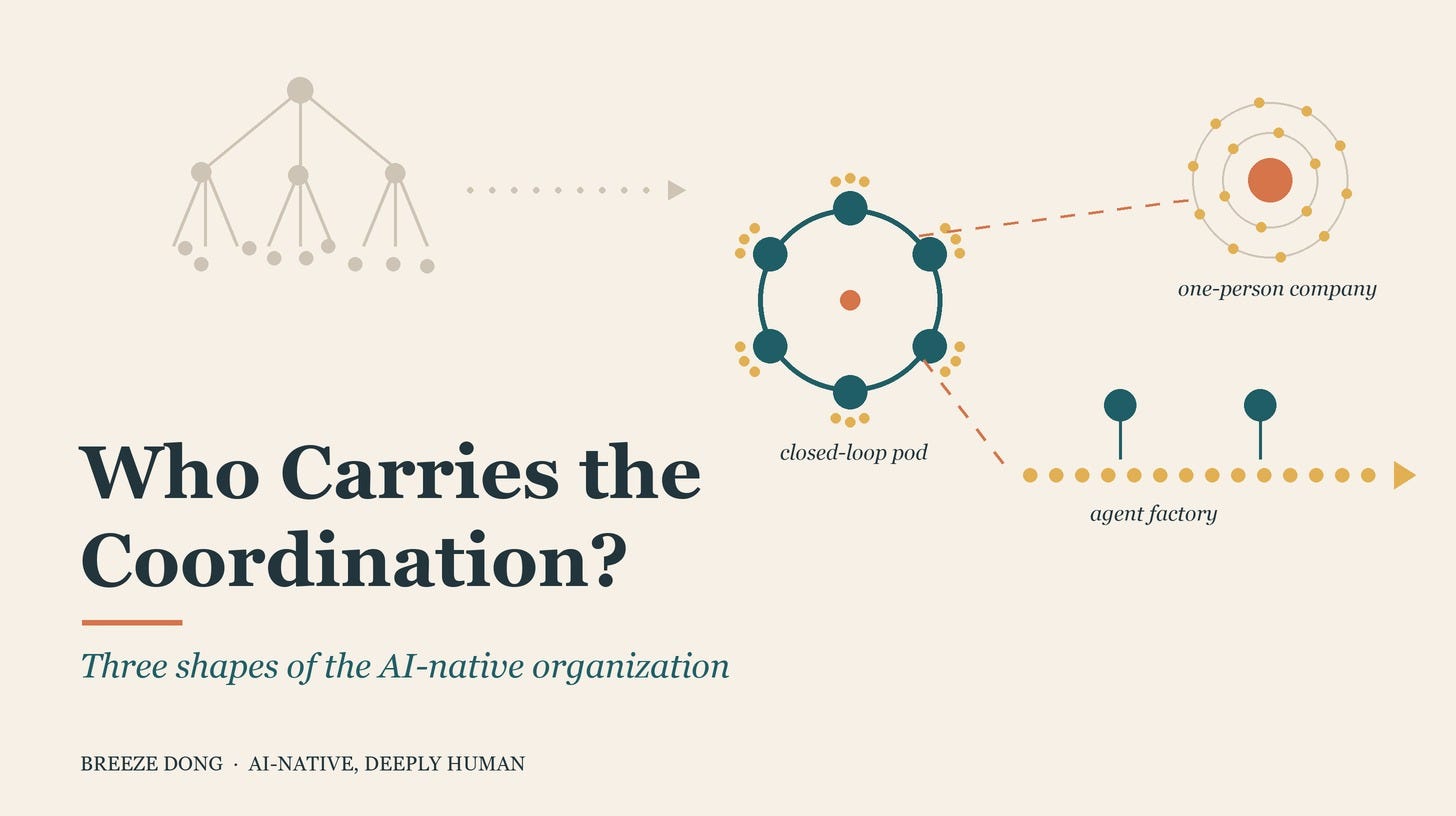
Three organizational forms are taking shape that close this gap in different ways: the closed-loop pod, the agent factory and the one-person company. Each breaks the hierarchy. Each lands in a small team that closes the loop end to end. And the third raises the sharpest question: what does it take for one person to be trusted with a whole loop?
AI-native organization design begins when AI carries the coordination
Hierarchy was never mainly about power. It was a way to route information. Five layers of managers carry a decision from the person who sees the problem to the person allowed to act on it, slowly, and with something lost at every handover. When agents can bring context to whoever needs it, in real time, much of that routing loses its reason to exist.
So the useful test of an AI-native organization is not how much AI it uses. It is where AI sits. As a tool people pick up, AI makes individuals faster. As the layer that carries coordination, it changes the shape of the organization.
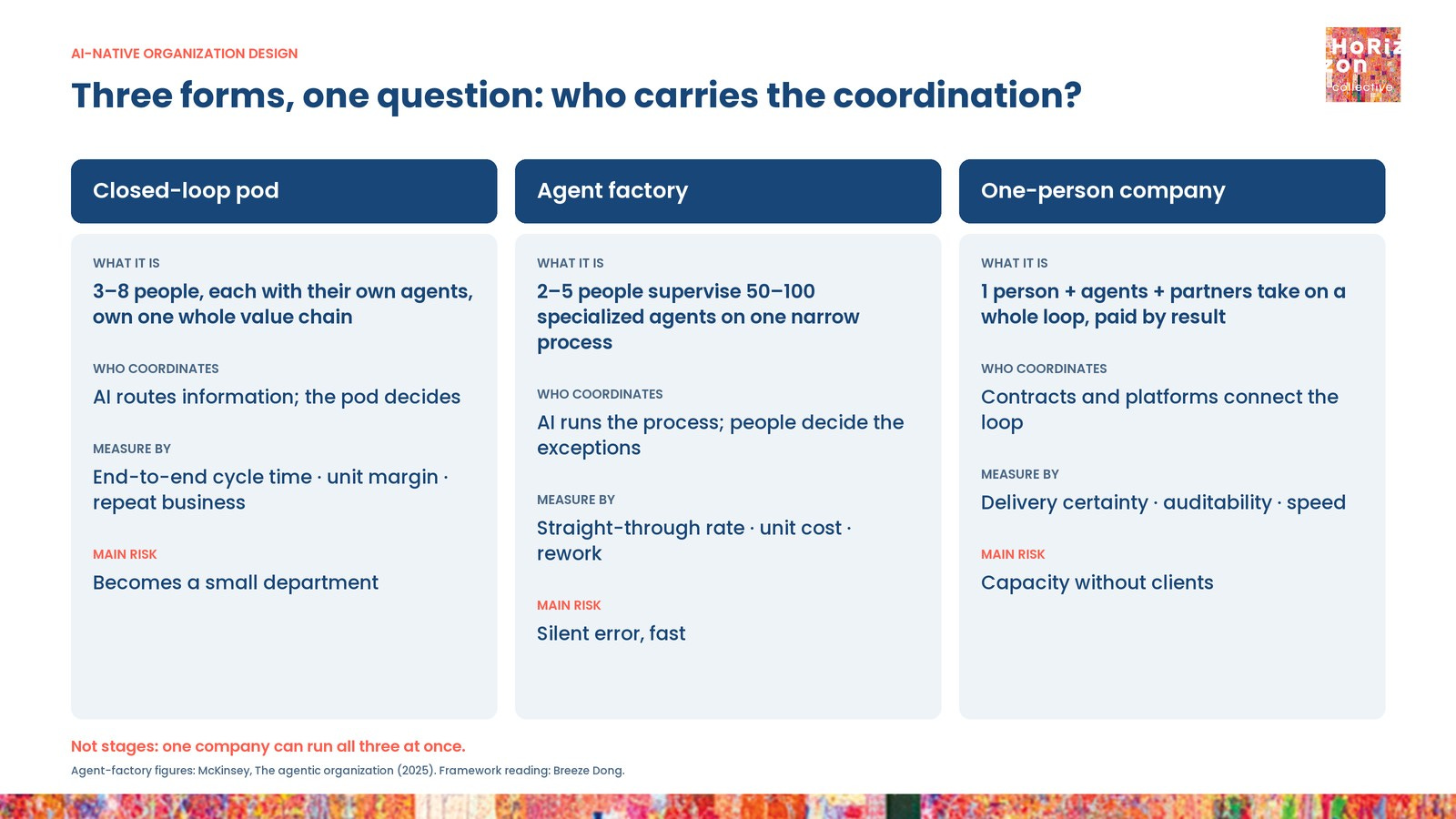
Seen this way, the three forms are not stages. They differ in one thing: who carries the coordination. One company can run all three at once.
Form one: the closed-loop pod owns a whole value chain
A pod is three to eight people, each working with their own set of agents, who own one value chain from start to finish. They answer for what the customer receives, not for their step in the process. Roles replace job titles: one person may carry commercial judgement, delivery and growth at the same time. Agents keep track of context and progress, so when people meet, they meet to decide.
One principle helps pods work: give more authority than feels safe, and slightly less budget than feels comfortable. With real authority and tight resources, a pod closes its own loop. With little authority and plenty of resources, it goes back to ask permission.
The common failure is a pod that turns into a small department, the same wall drawn smaller. The test is simple: can the pod decide what it will not do? In The Living Organization, Peng Wang and I call this Distributed Authority. Without it, a pod is a field office of the old structure.
Form two: the agent factory runs a narrow process at depth
The second form has the opposite temperament. McKinsey describes it in The agentic organization: a human team of two to five people supervising 50 to 100 specialized agents that run an end-to-end process. It suits work with clear steps, little judgement and high volume, such as customer onboarding, reconciliation, compliance checks and tender documents.
People do three things here. They write the rules for what counts as good. They decide the exceptions the agents raise. And they keep the evaluation set: real cases, checked by a human, that show whether an agent did the work right or only looked right. The danger in a factory is not slowness. It is silent error that travels quickly to the customer. The honest number is the straight-through rate, the share of work finished without a person stepping in. This is where Human–Agent Governance stops being a principle and becomes a daily routine.
The factory also has a trap: it can live comfortably inside the old organization. Efficiency triples, the process goes back under the same manager, and nothing else changes. That makes it the easiest form to start, and the easiest to fool yourself with.
Form three: the one-person company becomes the interface
The third form asks the most of the individual. A one-person company, or OPC, is not freelancing. It is a real business, with AI as its main means of production, that can sign a contract, issue an invoice and carry responsibility for delivery. A larger company hands it a whole loop and pays by result: local content for one regional market, a long-tail product line, solution delivery for one niche industry.
Why would a company trust one person with that? Not because they work hard. Because they can show five things.
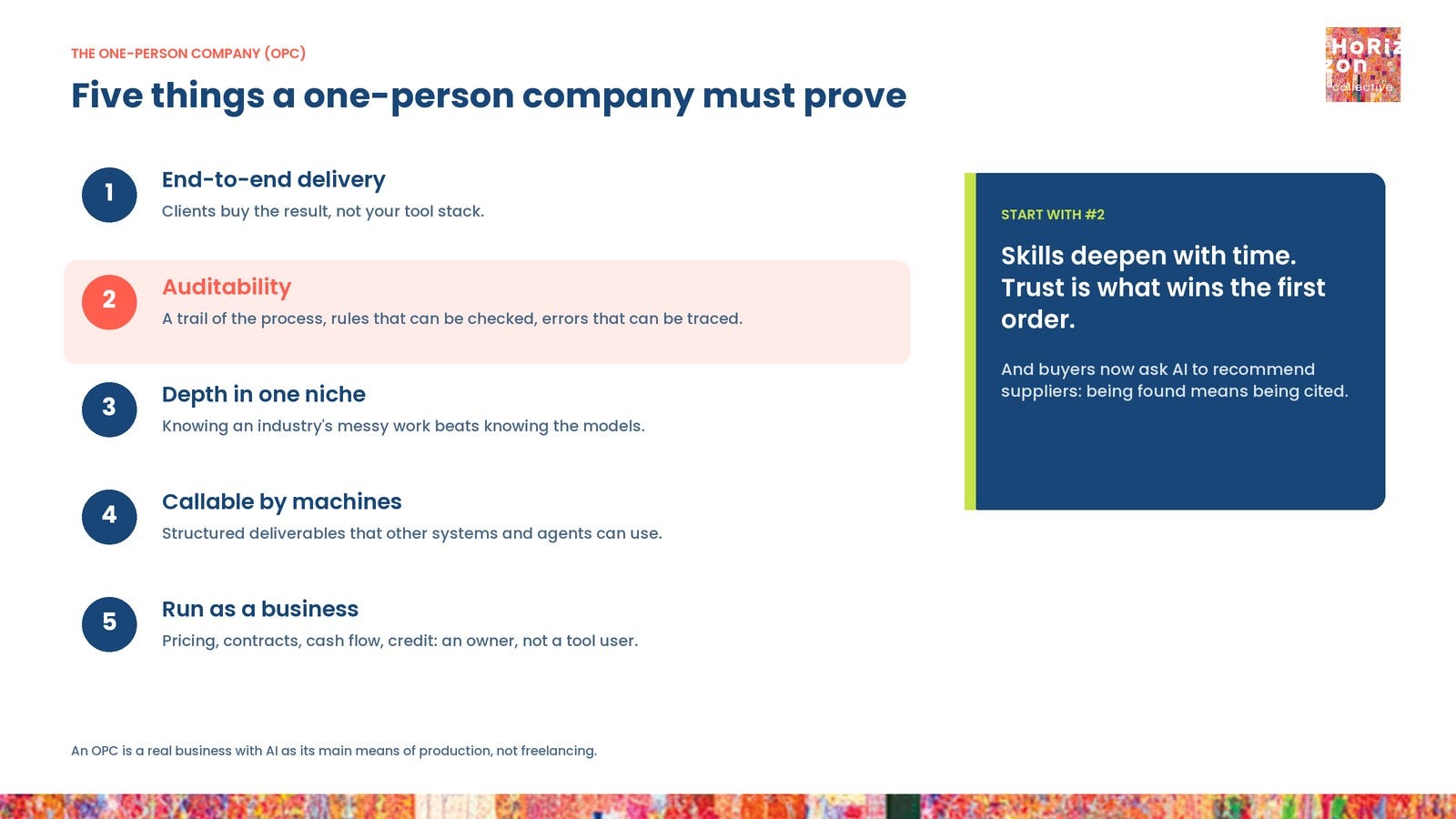
If I could choose only one to build first, it would be auditability. Skills deepen with time. But without a way for a client to see and check the process, the first order never comes, however good the work is. There is a second shift here too: buyers increasingly ask AI to recommend suppliers. Being found now means being cited, so the public trail of your work matters as much as the work itself.
What the three forms share, and what they ask of the middle
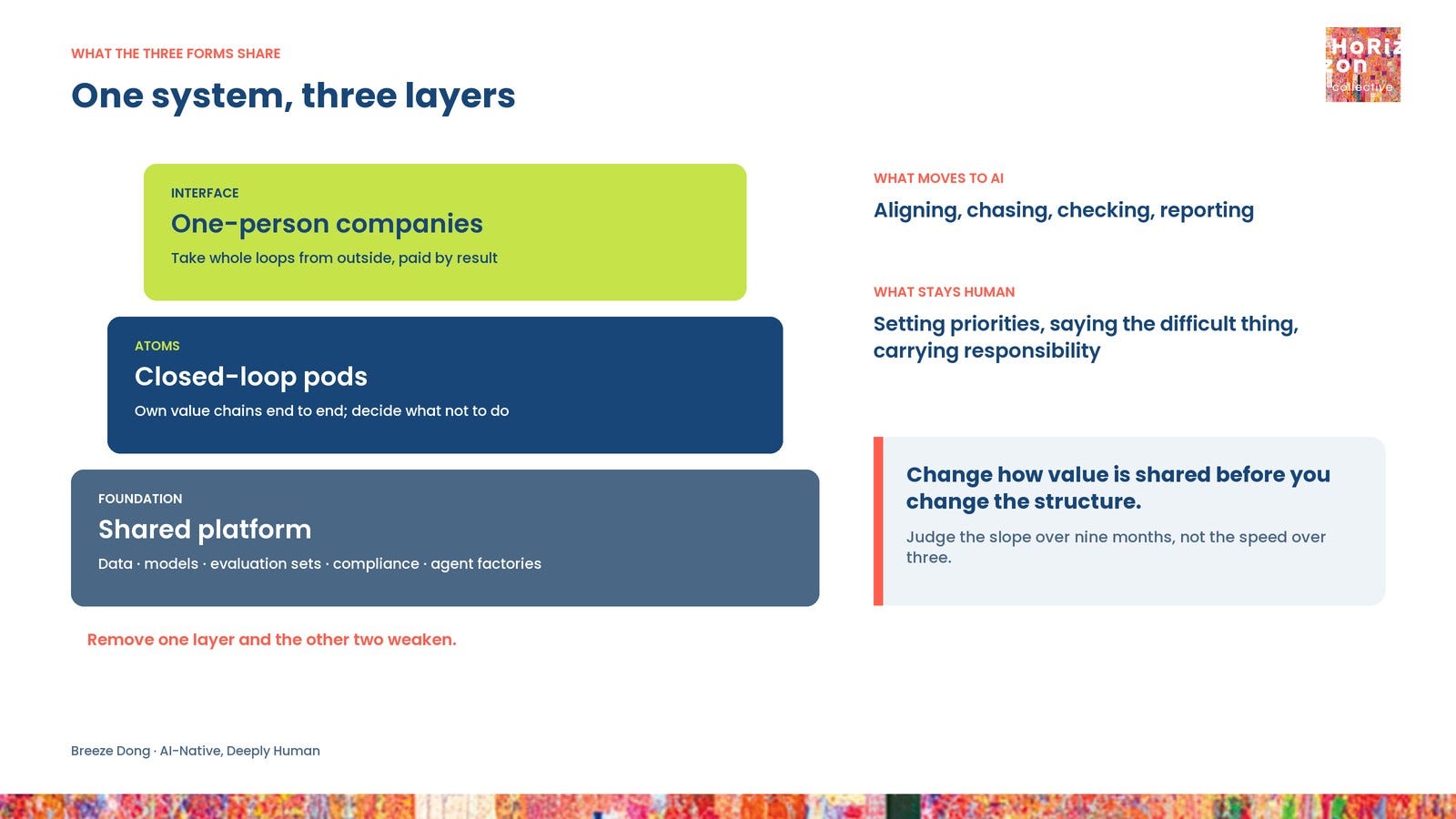
Put side by side, the forms make one system. Pods are the atoms. A shared platform of data, models, evaluation sets and compliance is the foundation. One-person companies are the interface to the outside. Remove one layer and the other two weaken.
In all three, the classic middle-management work of aligning, chasing, checking and reporting moves to AI. What stays human is setting priorities, saying the difficult thing and carrying responsibility. From coaching I would add that people in the middle rarely hesitate because they are lazy. Often they are carrying a question no one has answered for them: where is my place now? Treat them as capacity to redirect, not a cost to remove.
And change how value is shared before you change the structure. Flatten the layers while pay and rewards stay the same, and the old shape returns within a year. Share the dividend or stall.
A first loop you can draw tomorrow
Choose one value chain. Find three people who know it well. Draw it on one page and mark the narrowest point, where work waits longest. AI added where the flow is already wide is wasted; the narrow point is where the delay lives. That point is your first closed loop.
Expect efficiency to dip before it rises, because the frictions that meetings used to hide come into the open. Judge the change by its slope over nine months, not its speed over three.
So the question I would leave you with is not “Will AI replace me?” It is this: where is the narrowest point in the value chain you are part of?
Related reading
-
Four Consulting Firms, One Verdict — McKinsey, BCG, Deloitte and Gartner on AI-native organization design
-
The Org Chart Is the Real AI Strategy — ByteDance’s view of redesigning the company for AI
-
When a Giant Treats Itself Like a Startup — Tencent’s “reset to zero”, read as an organization design lesson
-
Start with the framework: The Living Organization: Five Pillars of an AI-Native Operating Model
Sources: McKinsey & Company, “The agentic organization: Contours of the next paradigm for the AI era” (2025), for the agent-factory figures. The three-form framework is my own synthesis.
Chunfeng “Breeze” Dong is an organizational development leader and executive coach (ICF PCC, CPCC) working on AI-native organization design. She has spent over twenty years in global enterprises, from strategy at Roland Berger to organizational development at Siemens, ABB and Roche. She is the author of A Soulful Transition and co-author, with Peng Wang, of The Living Organization. More: AI-native organization design · LinkedIn · Substack