This morning a WeChat article reached me before my first coffee. Tencent had turned 28, and its leadership team had used the anniversary to record a long conversation about the AI era. Tencent Culture published it as a long read with a striking title: start up again, and reset the mindset to zero.
I read it through the summary that AI组织进化论 (AI Organization Evolution) made of it, eight infographic pages and a short commentary. What struck me was not the technology. It was how much of the message was about organization.
A rumour about cuts, and a message about structure
A week earlier, a metaphor from the same event went viral in China. Leadership had spoken of “half army, half navy”, and social media read it as “cut 50% of staff”. Tencent’s PR director and several media outlets clarified that the claim was untrue. The metaphor described a reallocation, not a layoff.
I find that misreading telling. When an organization announces change, people hear threat first. That is not stupidity. It is a nervous system doing its job. Any leader who wants a company to move has to work with that reflex, not around it.
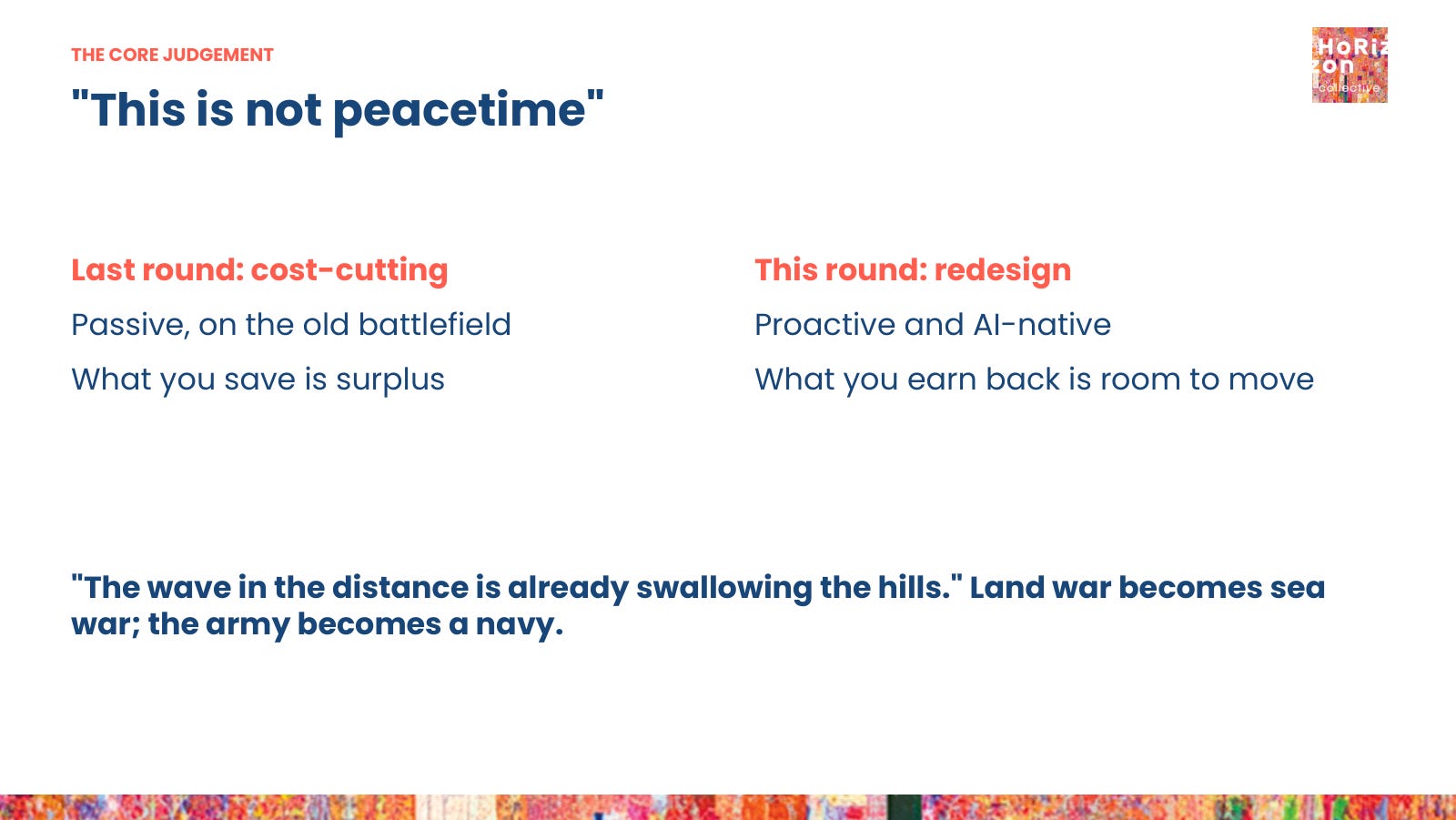
The actual message is sharper than the rumour. “This is not peacetime,” the leadership says. The core business looks solid, “but the wave in the distance is already swallowing the hills.” The last round of change was passive cost-cutting on the old battlefield. This round is meant to be proactive: land war becomes sea war, the army becomes a navy, and people are asked to move supplies, retool their skills and board the ship.
I like the distinction between the two rounds. Cost-cutting asks, “What can we stop paying for?” Redesign asks, “What would we build if we started today?” The first protects the past. Only the second creates room for the future.
Half defend, half attack
The playbook is simple to state. Flatten the organization. Half the people defend the legacy business and upgrade it with AI. Half go after new business that grows out of AI-native ground.
Then come four hard requirements, and this is where I slowed down:
-
Reset to zero. Drop the baggage; every team starts up again.
-
Organic organization. Flatten, and make small teams the unit of operation.
-
Process redesign. Redesign management itself with AI.
-
Break the fiefdoms. Don’t let message-passing, turf-holding managers become the obstacle.
Two words sit underneath all four: speed and talent density. Speed means immediate feedback, immediate decisions, immediate action. Talent density, in Tencent’s framing, is not a handful of stars. It is the whole workforce pulled up to the same level. For anyone working in OD, that second idea is the harder one. Hiring a few brilliant people is a recruiting task. Lifting everyone is a development system.
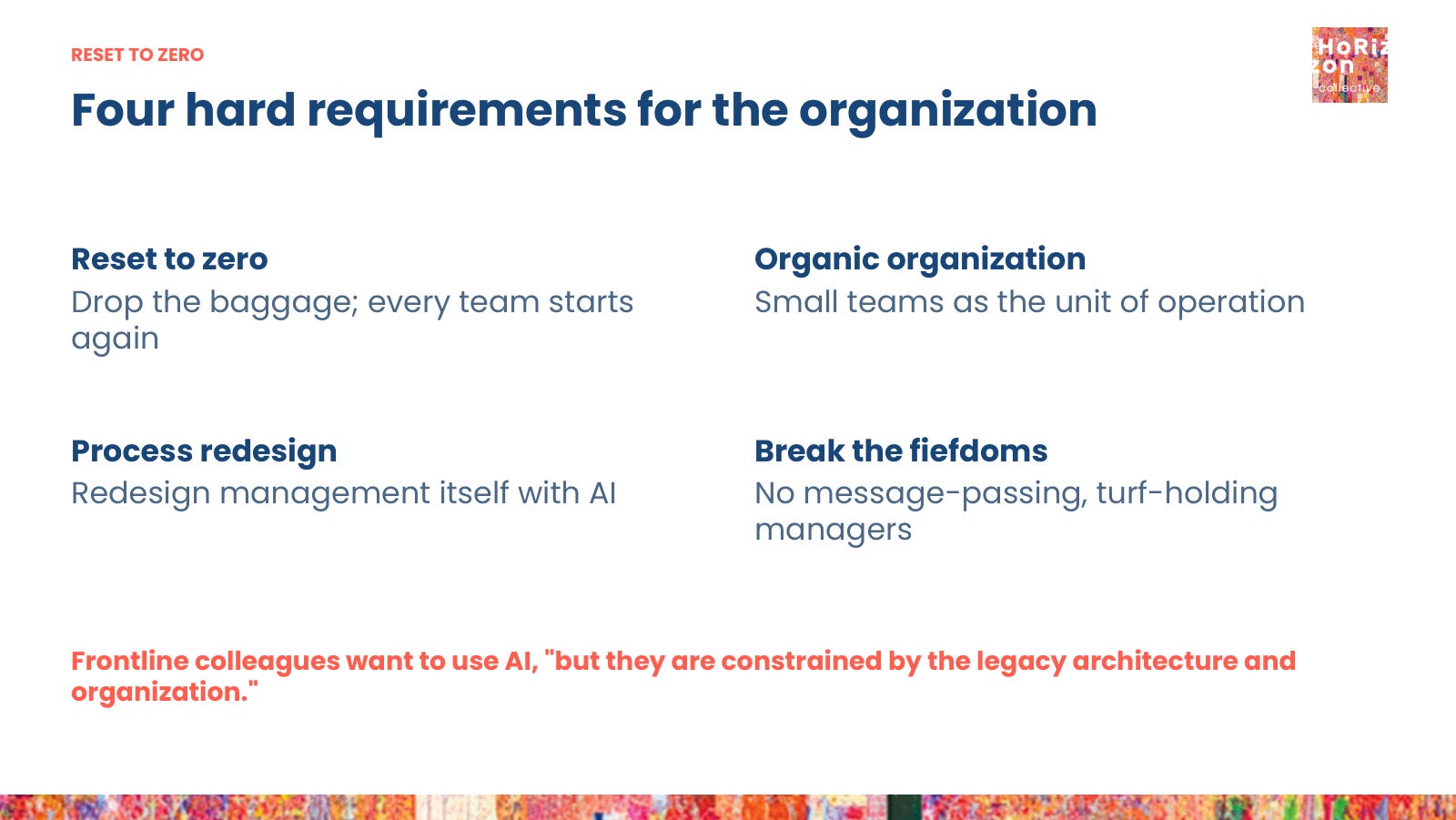
One line from the summary could sit in our own book. Many frontline colleagues, it says, are highly motivated to use AI, “but they are constrained by the legacy architecture and organization.”
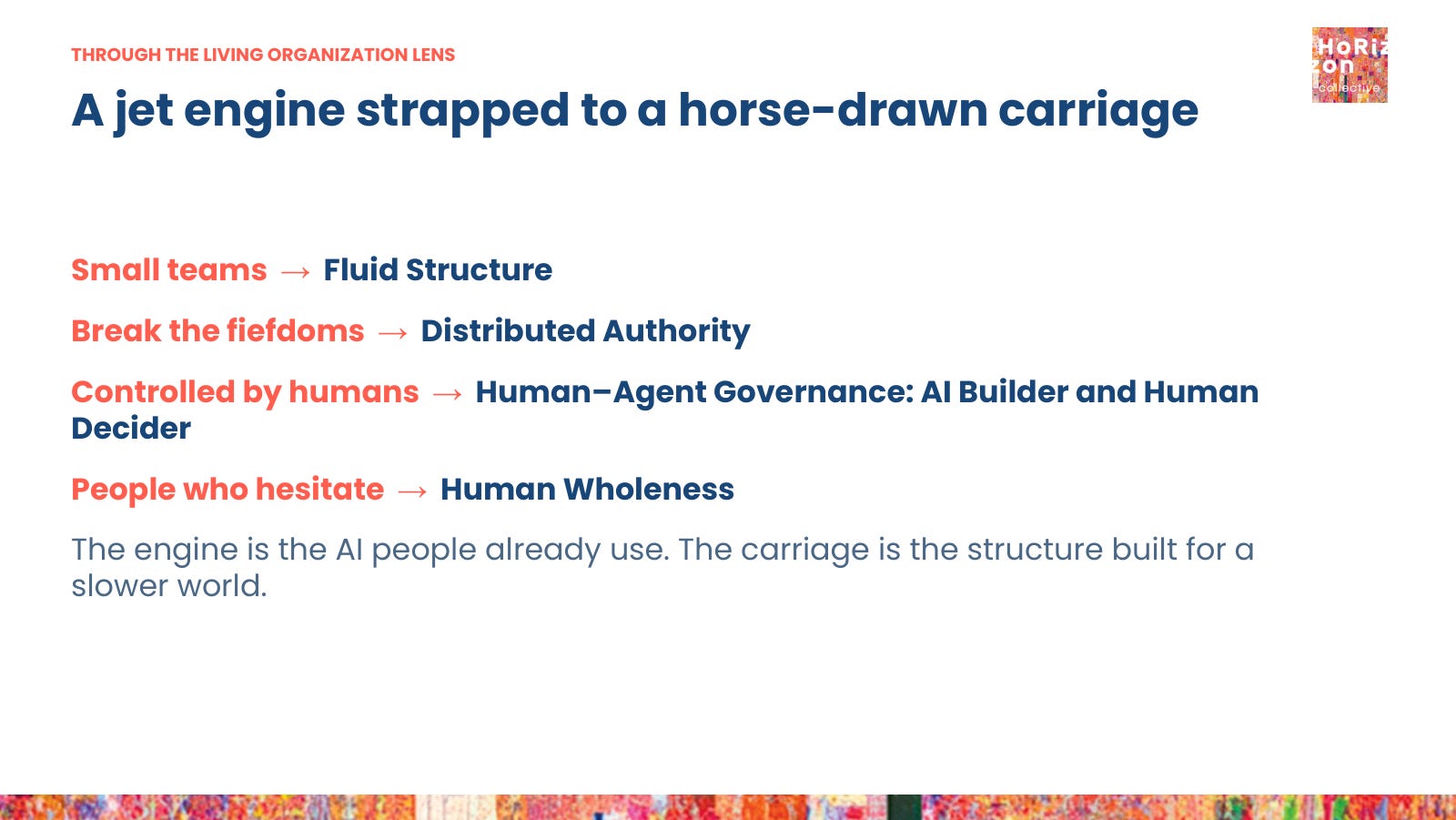
In The Living Organization, Peng Wang and I call this a jet engine strapped to a horse-drawn carriage. The engine is the AI your people already use. The carriage is the reporting lines, approval loops and silos built for a slower world. Tencent’s list maps closely onto our pillars: small teams are Fluid Structure, breaking the fiefdoms is Distributed Authority, and redesigning management is where the carriage finally gets rebuilt.
It is rare to see a company of tens of thousands put the organization, not the model, at the centre of its AI transformation. The commentary makes the same point, and I agree with it. Follow-through remains to be seen. But naming it is already a step most companies skip.
Human-centred, in the right order
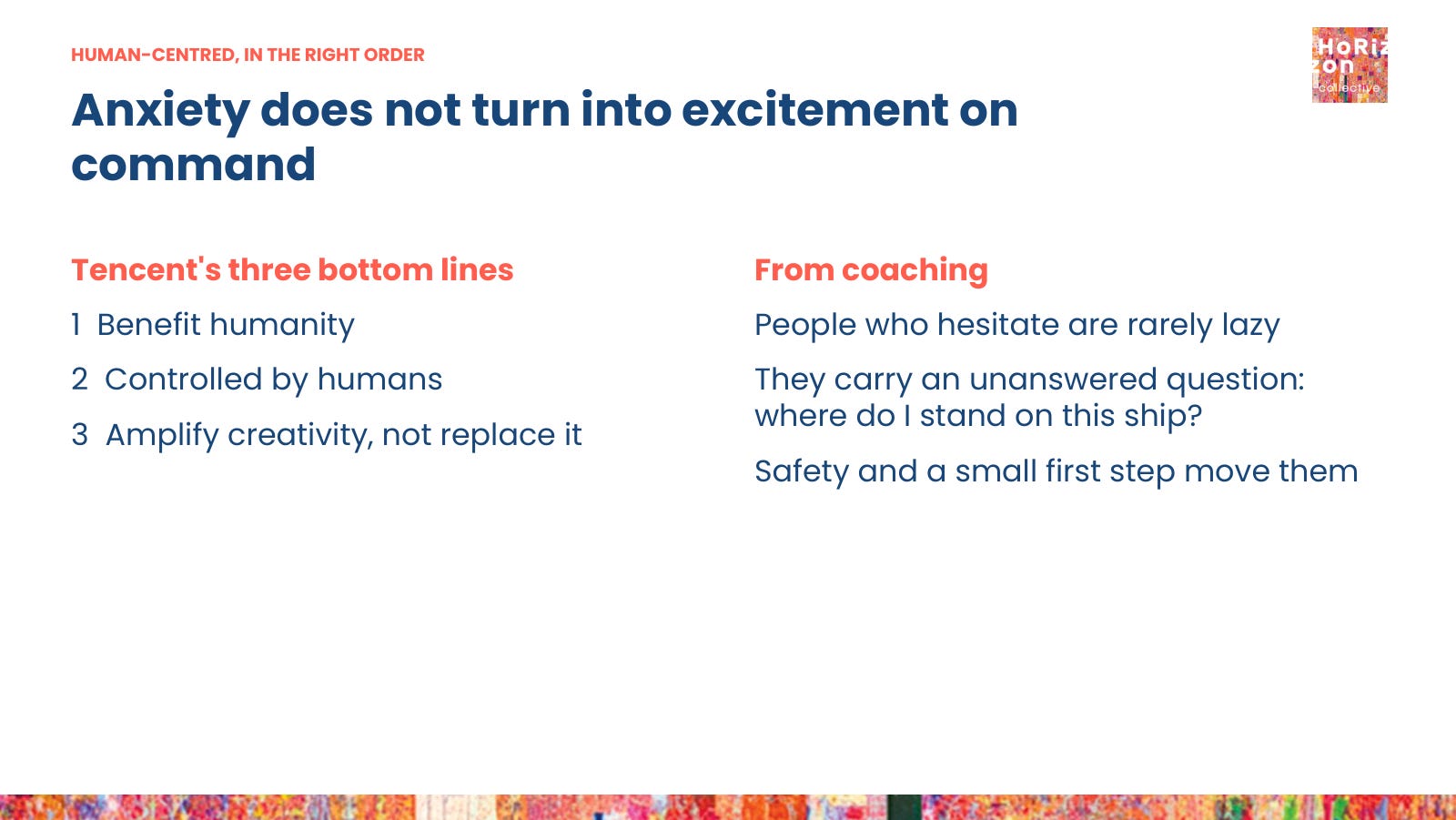
The second thread is values. The leadership sets three bottom lines for AI: it must benefit humanity, it must be controlled by humans, and it must amplify human creativity rather than replace it.
The order matters. Benefit comes first; control and creativity follow. In our book, Human–Agent Governance is the pillar that turns “controlled by humans” from a slogan into practice: who decides, who builds, who answers when an agent gets it wrong. We describe two roles, the AI Builder and the Human Decider. A bottom line written on a slide only becomes real when someone owns that decision. In practice, that means naming, for each agent workflow, the person who can stop it, and making sure that person has both the authority and the time to use it.
The commentary adds a point I have heard often in AI transformation research: companies that put people at the centre tend to move faster, because people who are not treated as a cost to be cut are far more willing to try.
The people waiting on the shore
Here is where I want to add my own voice.
The summary is blunt about who is wanted. Yes to people who adapt to the new playbook. No to people “who wait to be assigned, wait to be coaxed, and negotiate terms first.” It closes with “turn anxiety into excitement” and “move first, only then do you find opportunity.”
I understand the urgency, and I share the instinct that waiting is the riskiest choice. But from coaching I would add this: people who hesitate are rarely lazy. Often they are carrying a question no one has answered for them. Where do I stand on this ship? What happens to what I was good at? A rumour about 50% cuts spreads so fast precisely because those questions are left open.
Anxiety does not turn into excitement on command. It turns when people feel safe enough to try, and when the organization makes the first step small. To its credit, the summary’s final advice is exactly that: pick one small thing, get it working with a small team, then talk about rolling it out.
I also notice the role this gives to managers. If message-passing managers are the obstacle, the manager who stays is something else: someone who answers the unanswered question, makes the first step small and protects the team while it learns. That is a coaching role far more than a supervising one.
This is why Human Wholeness sits next to structure in our model, not after it. Design the machine to be AI-first, so that the people can be more human. A flatter organization with a frightened workforce is only a faster way to spread fear.
Three questions to carry
The summary ends with three self-check questions. I find them useful well beyond Tencent:
-
Is my area doing passive cost-cutting, or proactive redesign?
-
Is anyone on my team still waiting on the shore, and do I know what they are waiting for?
-
What is one step I can take today, with one small team?
The second question is the one I would linger on. If a 28-year-old giant can treat itself as a startup again, the rest of us have little reason to wait. Still, the ship leaves best when the people on board know why they are there.
Related reading
-
What Happens When the Org Chart Becomes an Orchestration Chart? — what happens to structure when agents join the team
-
The Company Was an Invention — if the firm was designed once, it can be redesigned
-
The Token Economy Is an Organization Design Issue — why the AI bill lands on the org chart
-
Start with the framework: The Living Organization: Five Pillars of an AI-Native Operating Model
Source: Tencent Culture’s LinkTime long read (16 November 2026), as summarised and translated from AI组织进化论’s article “刚刚|腾讯总办长文:心态归零再创业”. Quotes are my translation of that summary, not of Tencent’s full text.
Chunfeng “Breeze” Dong is an organizational development leader and executive coach (ICF PCC, CPCC) working on AI-native organization design. She has spent over twenty years in global enterprises, from strategy at Roland Berger to organizational development at Siemens, ABB and Roche. She is the author of A Soulful Transition and co-author, with Peng Wang, of The Living Organization. More: AI-native organization design · LinkedIn · Substack