Last week in Suzhou, at the China Growth Forum, Fang Weichun spoke for nearly ninety minutes to a room full of founders and CEOs. She leads AI organization research at Feishu, ByteDance’s work platform, and spent eight years inside the company, from its organization department to Zhang Yiming’s management office.
I was not in the room. I followed her talk through detailed notes and her slides, and one sentence stopped me: “How to redesign the company for the AI era is the biggest question facing CEOs in the next three years.”
Not which model to buy. Not which tools to roll out. How to redesign the company.
All in AI, AI in all
Her title was a small play on words: All in AI, AI in All. Business strategy can be “all in” on AI, she said. But organizational strategy has to be the other way round. AI has to reach every capillary of the company, and the company has to be rebuilt around it.
Her case came from history. Around 1900, factories swapped steam engines for electric motors and changed nothing else. Productivity stood still for about thirty years. The real gains arrived only in the 1920s, when factories were redesigned around electricity. Computers repeated the pattern: computing power rose a hundredfold in the 1980s, organizations stayed the same, and productivity growth fell. It recovered only when process reengineering broke the functional silos in the 1990s.
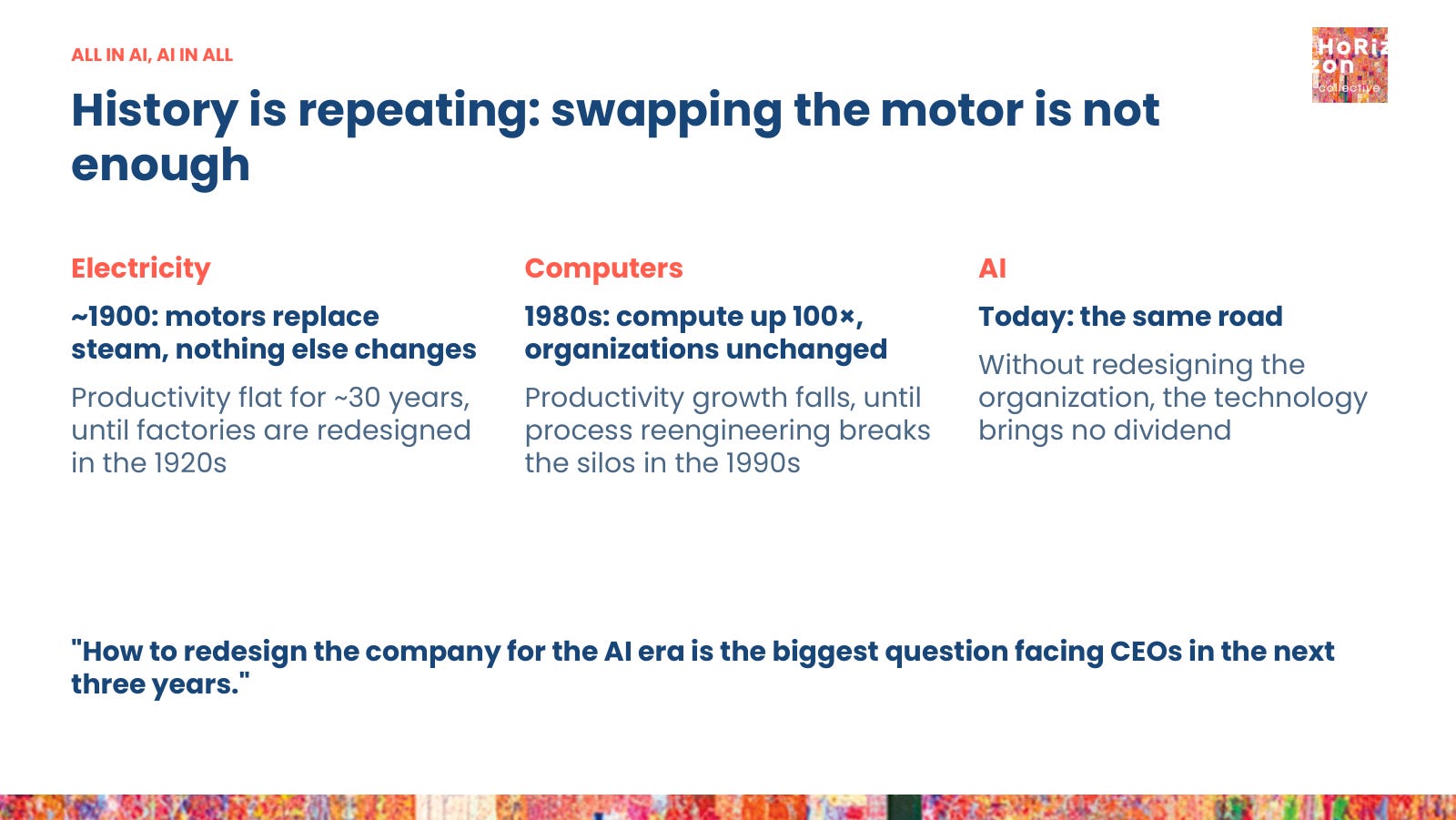
In The Living Organization, Peng Wang and I describe the same trap as a jet engine strapped to a horse-drawn carriage. It was striking to hear someone from inside ByteDance put the organization, not the technology, at the centre of the story.
Five wheels, read from left to right
Then Fang showed a picture she asked the room to photograph: five wheels drawn by Zhang Yiming, ByteDance’s founder. From left to right, they are management philosophy, tools, organization, business and commerce. Philosophy means setting goals, hiring well, and deploying and motivating people. Tools means data, technology and process, and today that means AI. Together, these two turn the organization wheel of culture, systems and talent. Only then come the wheels everyone watches: business (product, service, marketing) and commerce (revenue, profit, market value). Zhang Yiming’s point is blunt: business results are the natural overflow of organizational capability. When growth disappoints, don’t stare at the revenue wheels. Look back to the left.
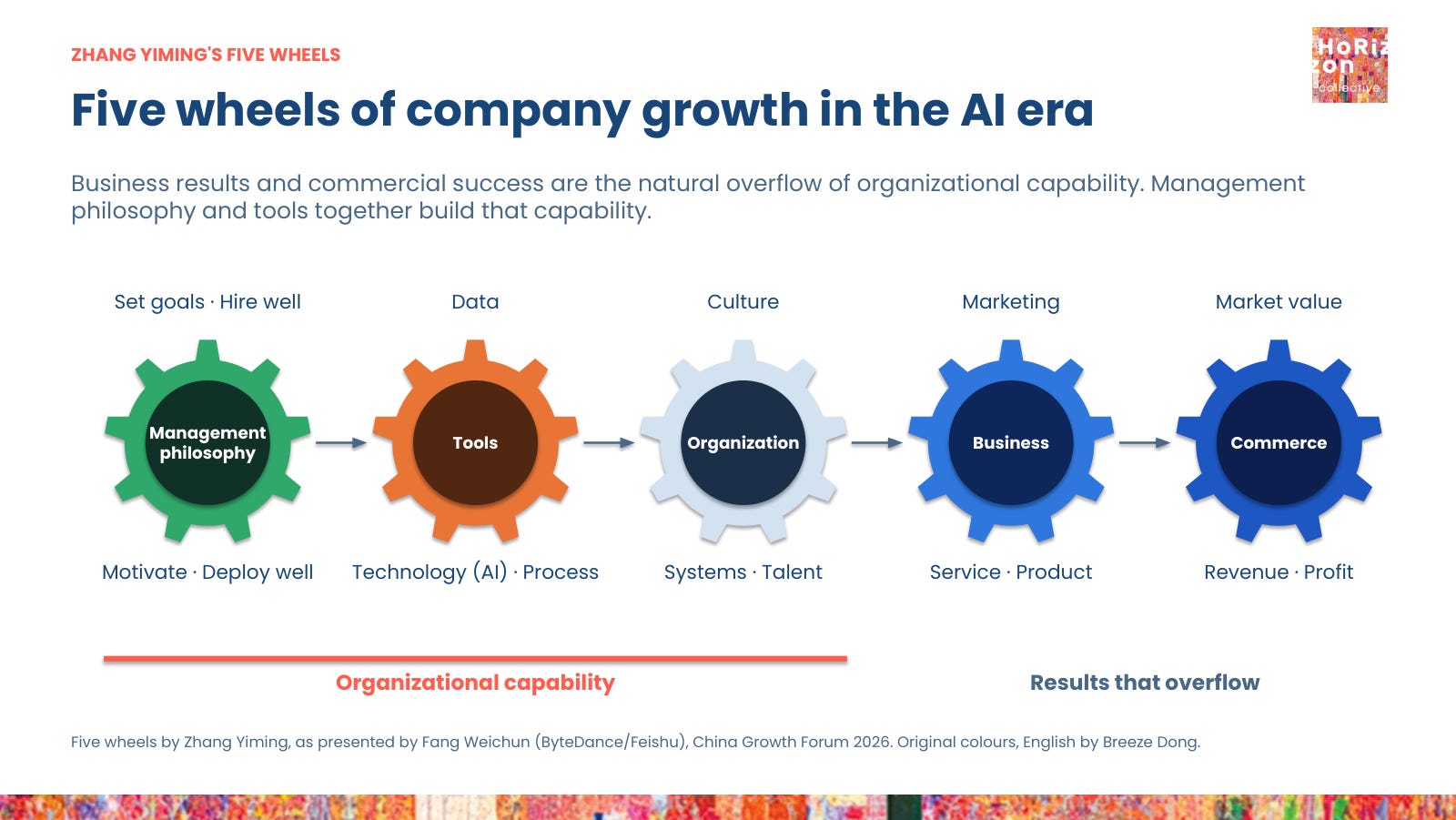
What I value most is the direction of reading. Many leadership teams read this picture from right to left, starting with the numbers and working back to the people. Zhang Yiming reads it from left to right. In a five-person company, Fang explained, philosophy turns almost directly into organization. At fifty, five hundred or five thousand people, the tools wheel has to carry it, and AI makes that wheel more powerful than ever before. In OD language, this is the case for treating organizational capability as the engine of strategy, not its side effect.
Digital employees, and the work humans keep
Fang’s first theme was human–machine collaboration. Treat AI less like a tool, she suggested, and more like a top performer joining the team. She described three steps: AI as a tool you ask and close; humans in the loop, with AI carrying a process from end to end; and humans on the loop, where AI agents work in small teams of their own and a person leads them.
The numbers she shared were bold. One ByteDance team, she said, has not written a line of code since late last year: AI writes it, the humans check quality, and the team’s output is eight times the company average. Companies that reshape the workflow around AI see a 67% higher return than those that only use it as a tool. “The gap is not in the model,” she said. “It is in the way of working.”
Her method had five steps: break the work down, set the boundaries, decide what goes to agents and what stays with people, orchestrate the agents, and review the results. In a fashion brand’s supply chain, a three-day process became fifty minutes, and routine orders now run automatically while people decide on the risky and high-value ones.
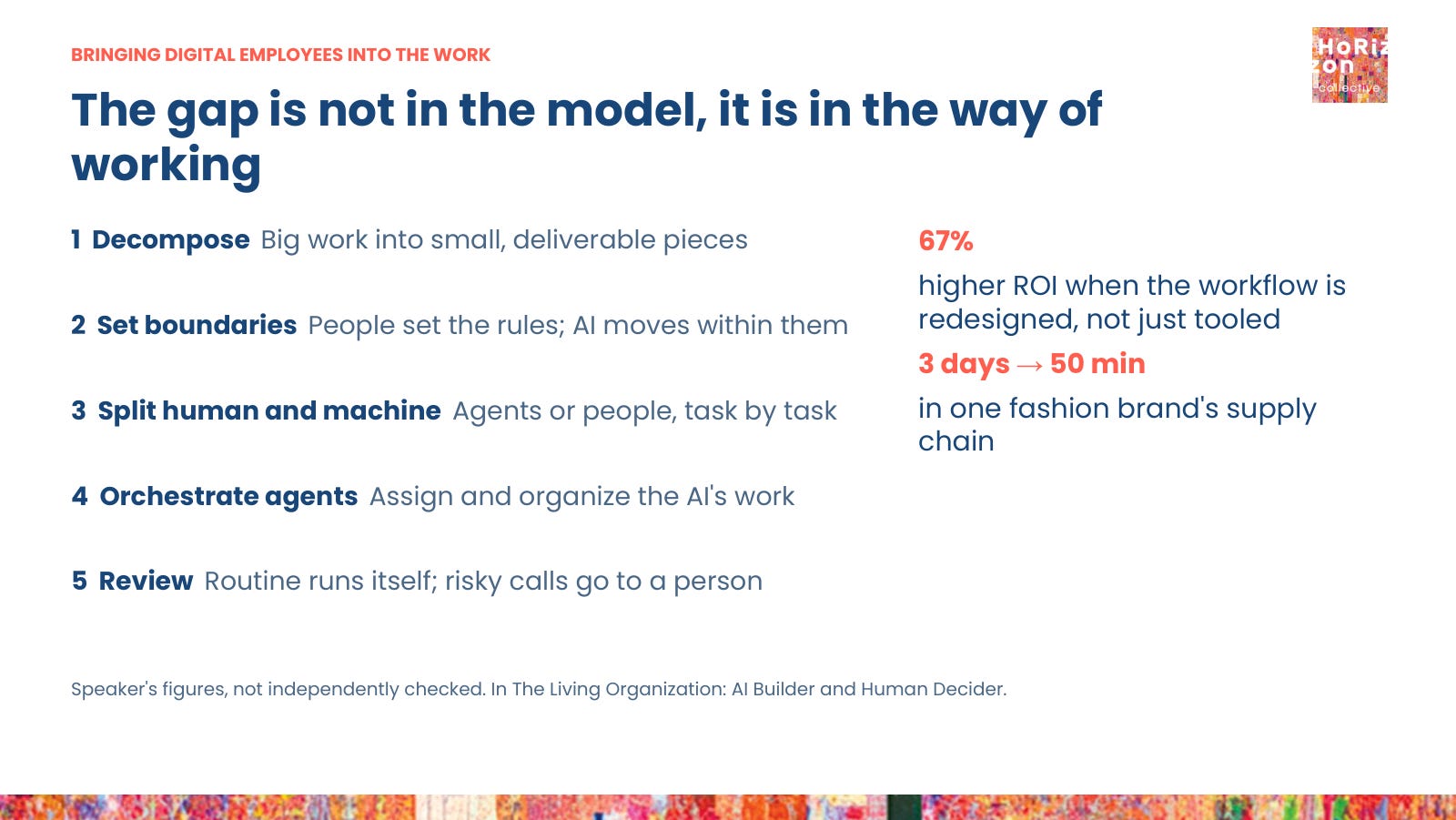
This is close to what we call Human–Agent Governance. The interesting work is not in the agents. It is in the boundary: who sets the rules, who reviews, who answers when something goes wrong. We call those roles the AI Builder and the Human Decider, and I was glad to hear her five steps land in the same place.
The middle layer moves up and reaches down
Her second theme was information. A company is an organism, she said, and information flow is its nervous system. ByteDance runs almost without slides: proposals are plain-language documents, meetings begin by reading together, the average meeting lasts fifteen minutes, and the rule for where to talk is simple: big group before small group, small group before private chat.
Then came the part I expect many managers will feel in their stomachs. The role hit hardest in this round, she said, is the middle layer. If AI can pass messages up and down and summarize reports, a manager whose job is relaying information has little room left. The managers who thrive will move up, aligning understanding and turning strategy into something that can land, and reach down, building teams and driving innovation. She mentioned pilots at Tencent and JD that remove titles or whole layers of management.
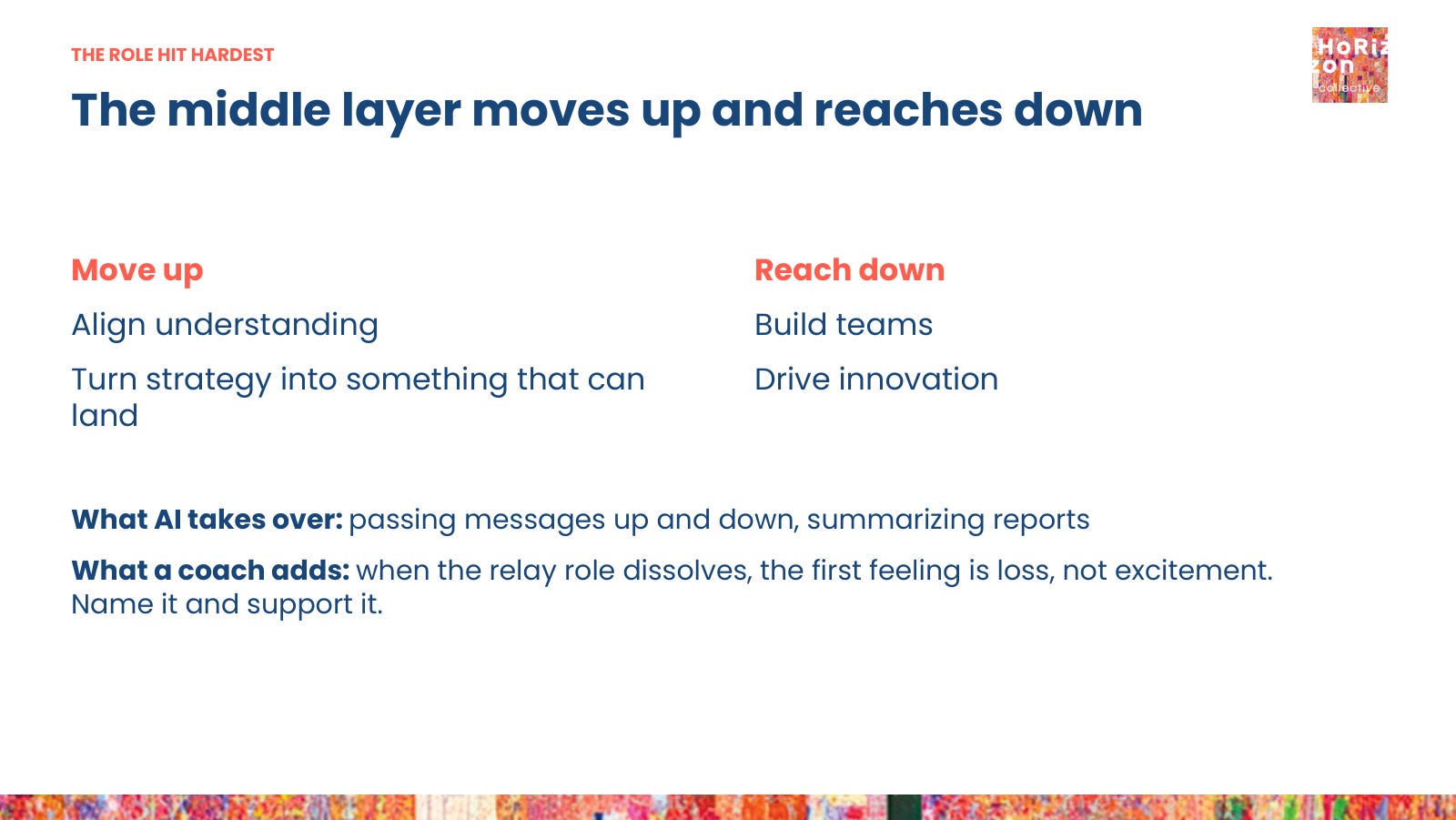
From coaching, I would add one thing. Moving up and reaching down are not only skills. They ask for a different relationship with your own value. Many middle managers I meet built their identity on being the one who knows, the one through whom everything passes. When that role dissolves, the first feeling is rarely excitement. It is loss. Organizations that name that loss, and support people through it, will see their managers move far faster than those that simply redraw the chart.
Knowledge only counts if it can travel
Her third theme was knowledge, and it held her sharpest line: knowledge and process only become a moat if AI can call on them directly. “If AI can’t use it, it doesn’t exist.” The goal, she said, is to move from finding heroes to mass-producing them, so that one star’s way of working can be reused across the whole company.
I agree with the direction, and I would hold it with some care. Much of what makes an experienced leader wise is not written down: how they read a room, when they stay silent, what they notice in a pause. That knowledge travels through mentoring, presence and trust as much as through documents. A company that only values what AI can retrieve may slowly stop valuing the rest.
She also described how far a CEO’s reach could grow: from about sixty working hours a week to perhaps ten times the capacity, sensing every key meeting and following every thread with agents. She quoted Jensen Huang, who has around sixty direct reports and says he would rather hear sixty people tell him the truth than one person tell him a filtered version.
That raises a question I explored in A Soulful Transition: what kind of mind can take in sixty truths without being overwhelmed? There I describe a shift from Processing, narrow and reactive, where AI already excels, to Presencing, which is wide and receptive and listens to what is not being said. A leader with ten times the information and the same inner bandwidth will not decide ten times better. Often they decide faster and worse.
Values are the zero or the one
Fang closed with a formula: organizational capability equals talent density, times AI leverage, times collaboration, times culture and values. The last term is a zero or a one. However strong the first three are, if values fail, everything goes to zero.
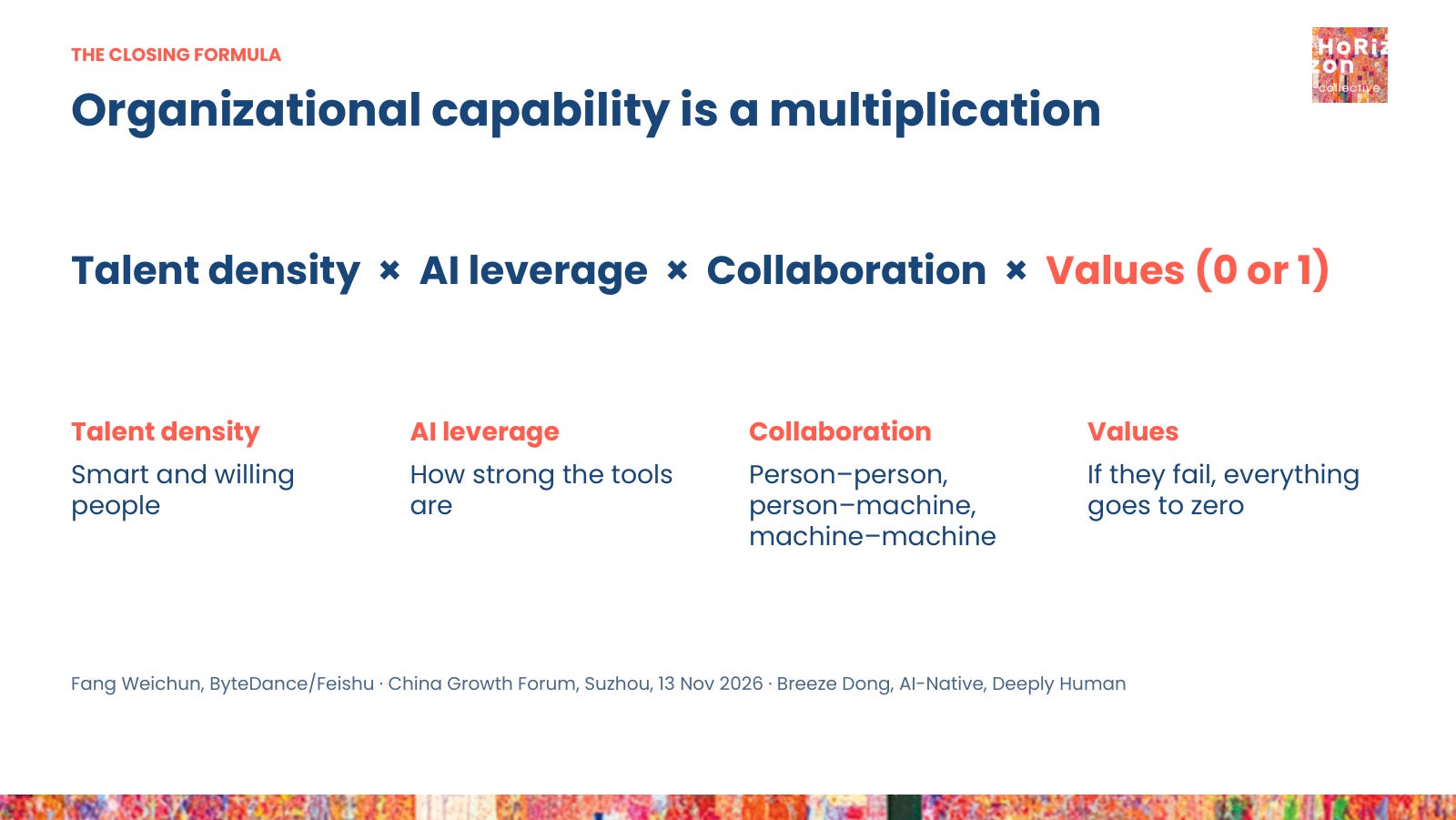
I love that she ended there. It is the same conviction behind one of our pillars, Human Wholeness, and behind a line we keep returning to: design the machine to be AI-first, so that the people can be more human.
Her practical advice for CEOs was refreshingly small. Use AI yourself on one real task every day. Ask each executive to get one scenario working with a technical colleague. List the few things that are truly yours to redesign. And set one goal per thirty days, then let the result speak.
I would add a fifth, for the people around those executives: ask each middle manager what they are afraid of losing, and listen to the answer. The org chart may be the real AI strategy. But the people inside it decide whether the strategy lives.
Related reading
-
When a Giant Treats Itself Like a Startup — Tencent’s “reset to zero” letter, read as an organization design lesson
-
What Happens When the Org Chart Becomes an Orchestration Chart? — what happens to structure when agents join the team
-
What Do You Have Left When the Machine Can Do the Rest? — why inner development belongs in the operating model
-
Start with the framework: The Living Organization: Five Pillars of an AI-Native Operating Model
Source: Fang Weichun’s talk at the GEONOL 2026 China Growth Forum, Suzhou, 13 November 2026, as reported in detailed attendee notes and her slides. Figures are the speaker’s, not independently checked; quotes are my translation.
Chunfeng “Breeze” Dong is an organizational development leader and executive coach (ICF PCC, CPCC) working on AI-native organization design. She has spent over twenty years in global enterprises, from strategy at Roland Berger to organizational development at Siemens, ABB and Roche. She is the author of A Soulful Transition and co-author, with Peng Wang, of The Living Organization. More: AI-native organization design · LinkedIn · Substack