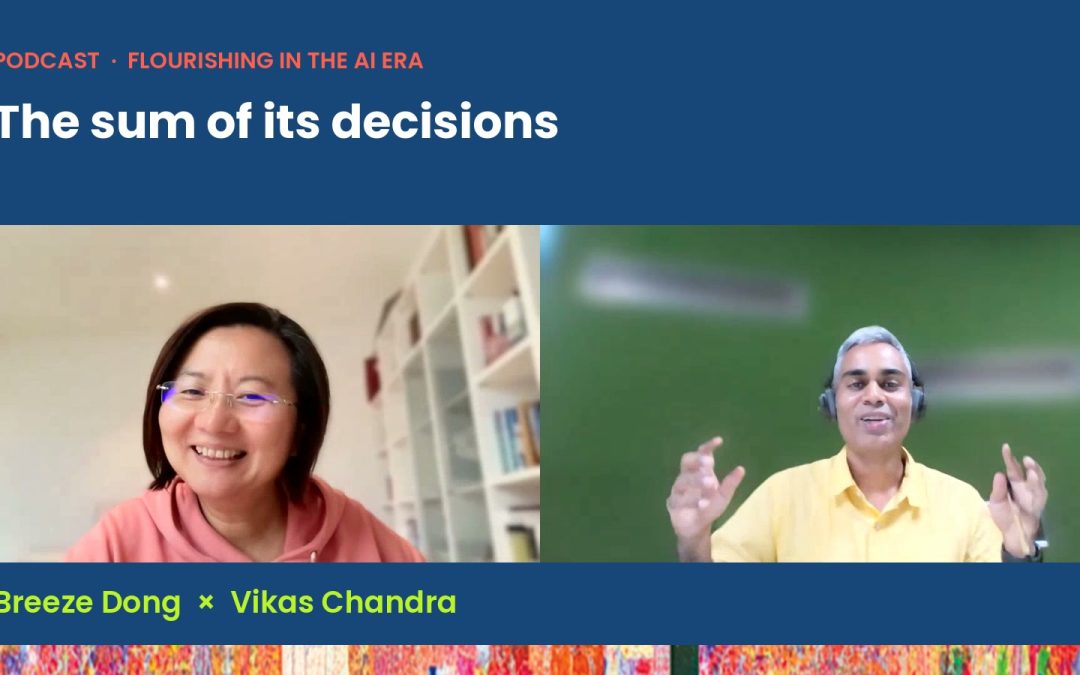
“An organization is nothing but the sum of all the decisions it is taking.”
Vikas Chandra said it while describing a design session with a friend. His friend’s video background happened to be a tree, and Vikas wondered: could an organization be as simple as a tree? Roots, a trunk, branches, leaves, each with one clear function.
They didn’t end up with a tree. They ended up with something more radical: designing the whole organization around decisions.
Vikas lives in Mumbai and has spent around 16 years helping leaders turn strategy into day-to-day action through operating models: decisions, incentives, meeting rhythms, KPIs. He wears two hats. One is inside a large organization, making AI work at scale. The other is greenfield: designing a new organization of humans and agents from scratch with a friend.
AI is an operating-model question
His first sentence about AI set the tone for the whole conversation:
“AI is not about technology. It’s about operating model. It’s redesigning the work.”
When they designed the new organization, Vikas and his friend first tried the familiar route: HR, finance, sales. It didn’t make sense. Instead, they asked three questions of every important decision: who decides, who executes, and who is accountable? Only then did they decide whether an agent or a human should do each task.
Three variables guide that choice. Risk: if it is high, humans only. Repeatability: a highly repeatable, low-risk task can go to an agent. Reversibility: an email can be taken back; a large payment cannot, so that stays with a human.
This resonated deeply with me. In The Living Organization, the first pillar of the AI-native organization is distributed authority: bringing authority to where decisions need to be made. Vikas had arrived at the same place from the operating-model side.
Habit and ego
What does building from scratch teach him about the large organization? His answer was honest:
“What is really stopping a large organization to succeed is its habit and its ego.”
And the small organization will one day be big, with its own habits and its own ego. So he is designing something I had never heard of before: a sanity function.
A sanity function
The idea is simple and very human. Take the last 15 critical decisions an organization has made. In Vikas’s experience, perhaps only four or five were taken by the people who were supposed to take them.
Why? Because a leader with two people, one capable and one a favourite, often gives the task to the favourite. There is no villain here. We give work to the people we trust.
Now add a third team member: an AI agent that may be the most capable of all. Decision rights shift again, and old habits decide where the work goes.
The sanity function exists to protect the operating model. It works with middle managers, where execution happens and where the informal organization lives. And crucially, it does not audit. It coaches. If you audit me, Vikas said, I will hide what I did. If you coach me, I will tell you why I gave the task to my favourite, and we can learn from it.
I have seen so many transformations fail at exactly this point: the org chart changes, and the real decision paths stay the same.
Every agent needs an accountable human
In the large organization, Vikas starts from the strategy, diagnoses what is stopping it, and then redesigns the decision-making system, adding agents where tasks are repeatable. It is incremental, not a big bang. One rule is non-negotiable:
“Every agent has to have an accountable human.”
He shared a story from sales. A copilot tool cut analysis and pitch preparation from five hours to two. Then came the real question: what do we do with the remaining three hours? The team redesigned the role around coverage, meeting more customers. And then HR borrowed the idea: if sales can cover more clients, why can’t HR cover more employees?
That is what I find most hopeful. The time AI gives back is a design decision, not a given.
Clarity over certainty
We spoke about the human side of change too. Vikas once led the operating model for a large merger and exceeded his synergy target. Yet his deepest satisfaction came from three or four people who thanked him for how he had treated them during those chaotic months.
I shared my own experience of being on the other side, being “optimized”, and the bottom of the U that I describe in A Soulful Transition: you have let go of the first trapeze bar, and the second hasn’t arrived yet. Vikas offered a reframe I will keep:
“The thing one should seek is not certainty, but clarity.”
Who am I here? How am I working here? Certainty is not available during change. Clarity is.
We both practise meditation, and he linked it directly to design work: a person sitting inside a picture can’t see the picture. You have to step out of the frame, out of your own thoughts and feelings, to see clearly. Good organization designers have to do the same.
Don’t panic. Be at it.
When CEOs feel the pressure to get AI right, Vikas tells them not to panic. AI for the sake of AI is not the point; measurable results are. No one has cracked it at scale yet.
“Don’t let this noise guide you. Be calm. It’s complex.”
But don’t walk away either. Be at it, because the potential is real.
His closing advice was the simplest of all: enjoy the journey, focus on the people you are carrying along, and remember that the first step is always to expand awareness. He sees his role with leaders as being a mirror, because the CEO role, for all its power, is often a lonely one.
I added my own practice: holding compassion for the wide spectrum of views in our society. It keeps me sane, and it keeps my energy for this work.
A few threads I’m holding
-
Design by decisions. Who decides, who executes, who is accountable, and only then: human or agent?
-
Audit less, coach more. Decision paths change when people feel safe enough to tell the truth.
-
Name an accountable human for every agent.
-
Decide what to do with the time AI gives back.
-
Seek clarity, not certainty.
Who really makes the decisions in your organization today?
The full conversation is in the video above, with subtitles. You can also listen to it as Episode 10 of Flourishing in the AI Era. I’d love to hear what you see.
Breeze Dong is the author of The Living Organization and writes AI-Native, Deeply Human. Vikas Chandra is an operating-model and transformation leader based in Mumbai. His views are his own.
Chunfeng “Breeze” Dong is an organizational development leader and executive coach (ICF PCC, CPCC) working on AI-native organization design. She has spent over twenty years in global enterprises, from strategy at Roland Berger to organizational development at Siemens, ABB and Roche. She is the author of A Soulful Transition and co-author, with Peng Wang, of The Living Organization. More: AI-native organization design · LinkedIn · Substack