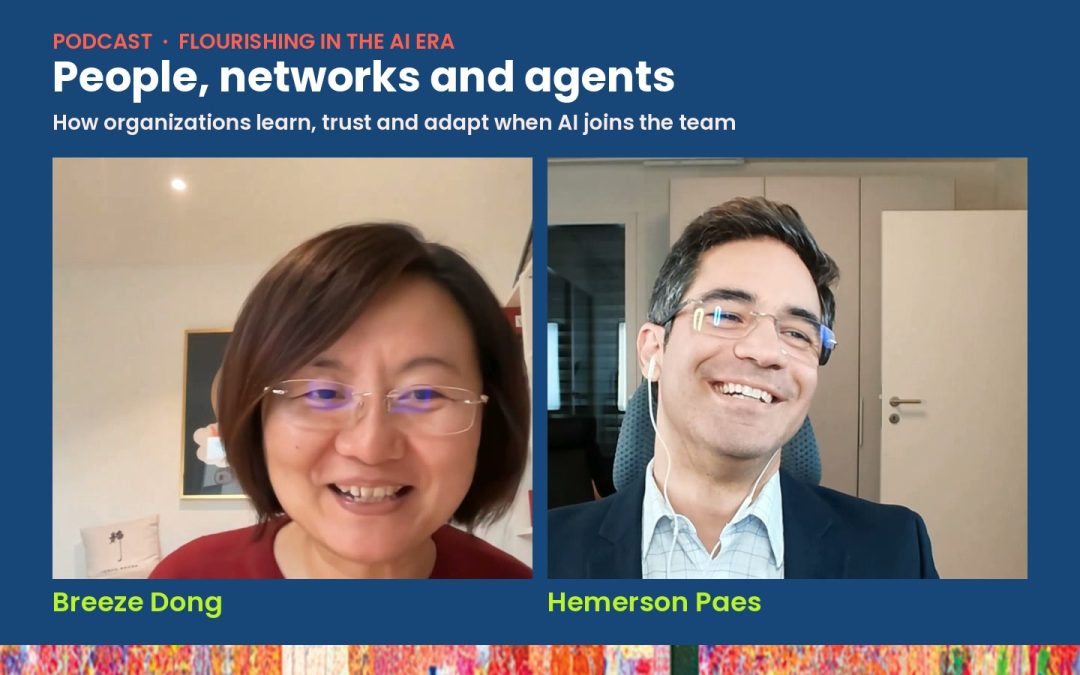
Watch on YouTube: AI and Organizational Learning: People, Networks and Agents, with Hemerson Paes
Starting in 2020, Hemerson Paes and I worked side by side on several organizational network analyses (ONAs) in a large organization. Each one began with a few simple questions. Who do you go to for inspiration? Who do you trust? Who gives you energy?
The answers drew a map no org chart could show. People everyone relied on, yet nobody had named. When we invited these hidden connectors to a community session, many wrote back surprised. They had never realized how much they mattered.
Something else moved me. Many people told us the survey itself made them stop and ask whether they had the right relationships at work. Asking the question was already an intervention.
On the new episode, Hemerson, who is now researching how organizations adapt to AI, and I came back to that work. This time, AI agents were in the room with us.
AI is not software you install
Hemerson put it simply: AI isn’t something you install and leave running. Its value depends on the context and the task, and the models change every few months. So the capability that matters most is organizational learning.
That landed for me. Everyone in a workplace is learning right now. But individual learning that never spreads is as good as if it never happened. In our adaptive teams, the boundary spanners carried tacit knowledge from one team to the next. AI can summarize what has been written down. Much of what we know never is.
The job description is already fiction
Hemerson cited research suggesting that AI can fully take over only about 1.5% of jobs, while around 40% could be accelerated. Yet even that is measured against job descriptions, and in our own mapping years ago, most were out of date within three months.
So the real work is to look at the value stream as it actually flows across silos, and at the tasks people really do today. Most of us are still organized by function. That, more than the technology, is why becoming AI-native feels so slow.
Agency, or bureaucracy at machine speed
Thoughtful observers of AI increasingly name the same few human capabilities: deep knowledge, broad curiosity, taste, and agency. Hemerson added one more: the ability to connect with other people.
Then he named the risk I find most real. Many companies will put AI on top of what they already have, and get bureaucracy at machine speed.
People with agency become “super individuals” with AI, as a recent Tencent report calls them. They also trigger the organization’s immune system. Whether a company punishes them or makes room for them may decide whether it flourishes.
Not too tight, not too loose
In China I watch one-person companies gather for demo days, testing ideas with fifty strangers in a shared office. They use AI intensely, yet they seek each other out. Trust, as Hemerson reminded me from his years visiting suppliers’ factories, is still built in the room.
The day before we recorded, I sat for seven hours of silent meditation. Insights came that only space allows. AI gives me so much energy that I tend to run all week. What works best is not too tight and not too loose.
Where in your work is there space to experiment and learn?
🎧 Listen to the podcast episode: Ep. 8 — People, Networks and Agents, with Hemerson Paes
Chunfeng “Breeze” Dong is an organizational development leader and executive coach (ICF PCC, CPCC) working on AI-native organization design. She has spent over twenty years in global enterprises, from strategy at Roland Berger to organizational development at Siemens, ABB and Roche. She is the author of A Soulful Transition and co-author, with Peng Wang, of The Living Organization. More: AI-native organization design · LinkedIn · Substack