🎧 Prefer to listen? The full narration of this essay is free — listen here.
Prefer to read? The full case follows.
Most companies measure AI adoption by licences deployed. Lenovo measures it by asking, for every agent it runs, which named person answers for what it does.
This is the other half of the Lenovo case. The first half is about work: agents were given jobs, so the jobs had to be redesigned. This half is about accountability — and it is the half that is harder to copy, because it costs something to give away.
The numbers first — because they earn the right to the argument
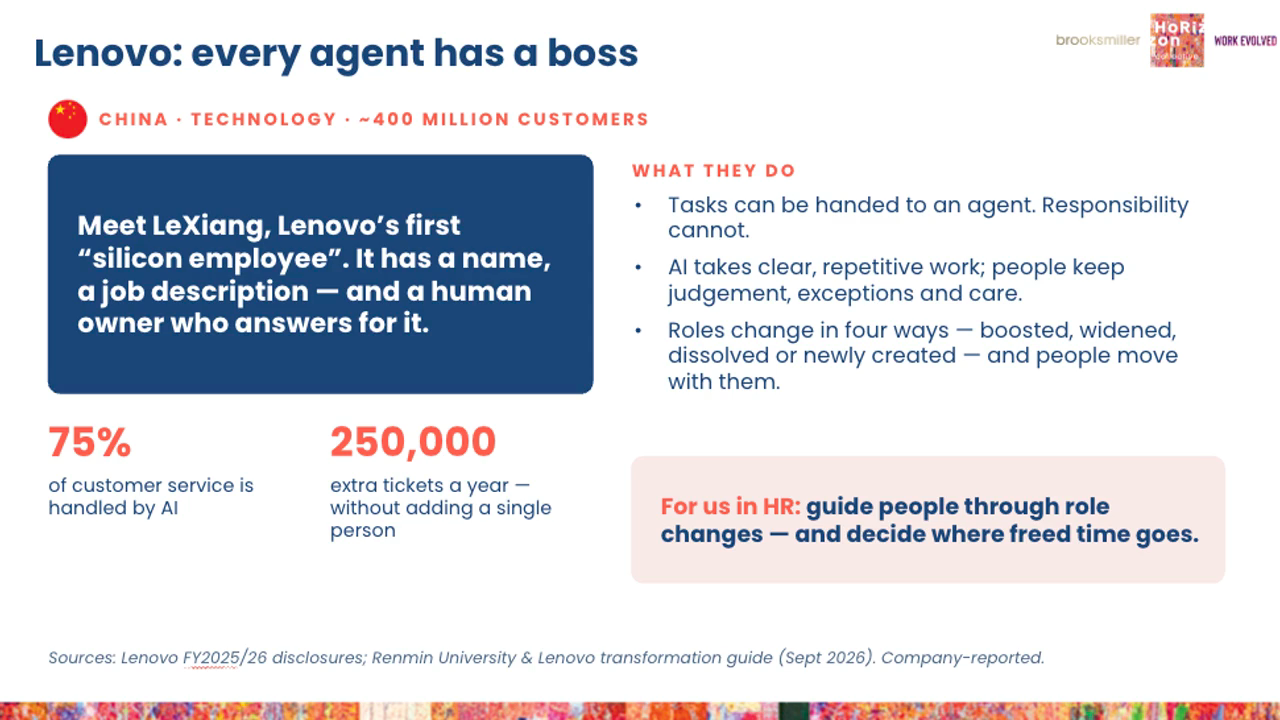
Lenovo’s China business serves close to 400 million customers, and its 3 + 100 + N system — three “super agents,” more than a hundred scenario agents, and a growing library of skills — now has a named human owner on every single agent.
The results are real: sales conversion up 23 percent, research and development efficiency up more than 30 percent, delivery cycles 28.5 percent shorter, and three quarters of customer service handled by AI while absorbing an extra 250,000 tickets a year without adding a single person.
But the number that matters for this half of the story is not a productivity figure. It is that every agent has one named human business owner who sets its objective, grants its permissions, makes the call when it is genuinely a call, handles the exception, and accepts the result — with a full record, so that any decision can be reconstructed afterwards. Permission boundaries and sandboxes were built before go-live.
Impressive. Also not the point.
The point is that an agent with a role owes you three answers
Naming an agent sounds like branding. It is not. A name is the first thing you give something that will hold a role. And once an agent holds a role, you owe it three answers rather than one: what may it do alone, what may it do only under human review, and what must it never do.
Those three questions are the Machine Governance Matrix, and Lenovo is the case in this series that publishes its answer. It rates each agent from L1, basic assistance, to L5, full autonomy — and its flagship agent sits at L3, limited autonomy. Published, by name, in advance. Analysis from the China Academy of Information and Communications Technology treats limited autonomy as the ceiling of real practice today rather than a waypoint, which makes the disclosure braver, not softer.
One confusion is worth clearing up, because two five-level scales are now in circulation. The scale Lenovo publishes for its agents measures how much an agent may do alone. The scale in the guide it published with Renmin University of China measures how far the organisation itself has changed — from isolated AI use, through a shared AI foundation, to work rebuilt around it. On that second scale Lenovo rates itself at level four and says plainly that it is not yet a fully AI-native company. Two different questions; a company can be high on one and modest on the other.
Most organisations never answer either question in writing. Lenovo answers both publicly and then says its own answers are provisional. That is what makes them checkable.
And here is the mechanism: the named owner
If one sentence from this case belongs in your next leadership meeting, it is Lenovo’s own, stated publicly: tasks can be handed to an agent, but responsibility cannot.
The Named Owner is how that becomes an operating rule rather than a slogan. One person per agent. Not shared between “the system,” the vendor and the team. It sits with a person — which is why “the system did it” is not a sentence this organisation can say. Accountability is not a document; it is a name.
Lenovo pairs that with two design choices most AI programmes get backwards. The first is that business owners lead, not IT. Technology teams build the platform and connect the models, but revenue growth, cost control and new business models stay with the business leader, and value is tracked at three levels against real money. Lenovo’s own vice-president for China transformation names the three mistakes behind unprovable AI returns: choosing the lowest-risk scenario rather than the highest-value one, counting the easiest value rather than the largest, and scattering pilots that never join into a line.
The second is that governance is planned for as a cost. Lenovo is building a system covering data and knowledge, agent behaviour, architecture, security and compliance, and token budgets — with clear permissions, boundaries on behaviour, ownership, and ways to pause, trace back and repair. It also describes the data agents need differently from the dashboards managers used. An agent does not need a report; it needs the meanings, relationships and business rules of the enterprise. A pricing agent must know how products, customers, costs and promotions relate, and which discount authority and approval rules apply. Give it the report and it will hallucinate fluently.
The hard part is the leadership flywheel
The most striking part of Lenovo’s published guide is where it locates the final constraint.
It describes three flywheels that must keep turning — leadership, talent and culture — and its CTO says plainly that the leadership flywheel is the ultimate limit. Leaders must first become aware of how they think, then stay personally close to the work, and finally change how they decide.
That is a remarkable thing for an engineering-led company with these numbers to publish. It is also the argument of this book, arriving from the opposite direction — process, data, agents, returns — and reaching the same conclusion: no organisation rises above the consciousness of the people who lead it.
The uncomfortable half
Two honest caveats keep the governance story from becoming a brochure.
The first is that published is not audited. The figures are company-reported; the guide and the award are not inspections; some sub-metrics vary between sources; the case covers the China region, not the group; and Lenovo sells this expertise as a transformation partner. A public autonomy rating is a commitment, not proof — though it is a commitment that can be held against the company that made it, which is more than most offer.
The second is the human half. Lenovo says the people whose time was freed were redeployed, not removed. There is no public data yet on how many moved, or whether the new work is better. And 250,000 tickets absorbed without adding staff is growth absorbed — but it is also a reminder that the same capacity could have been removed by a company that chose differently. Identical tools, identical diagnosis, opposite answer. Which branch an organisation takes is a values decision, not a technical one.
What Lenovo has done is make the accountability side of that decision explicit, in writing, with names attached. The harder question — which roles should be AI-led at all — is the first half of this case.
Design the machine to be AI-first, so that the people can be more human.
One question to hold this week: could you name the human owner of every AI agent working in your organisation today?
Sources: Renmin University of China and Lenovo, AI-Native Organizational Transformation Guide (20 September 2026); Lenovo FY2025/26 disclosures; the China Management Model 50+ Forum (C50+) 2026 award and its published site-visit write-up; Economic Observer, NetEase and 21st Century Business Herald (September 2026); China Daily; Eastmoney; the China Academy of Information and Communications Technology on limited autonomy. Framework reference: Chunfeng “Breeze” Dong and Peng Wang, The Living Organization — the AI-Enabled Living System, its five pillars, the Machine Governance Matrix and the Named Owner. Figures are company-reported. Lenovo is not a client or affiliate.
Mirrored from AI-Native, Deeply Human, the newsletter by Chunfeng “Breeze” Dong. Get new essays by email.