
🎧 Prefer to listen? The full narration of this essay is free — listen here.
Prefer to read? The full case follows.
On 16 July 2026, a Beijing company released a new AI model. Within forty-eight hours, demand came so close to the limits of its computing clusters that it stopped accepting new consumer subscriptions. That is what a launch looks like when the product is frontier intelligence.
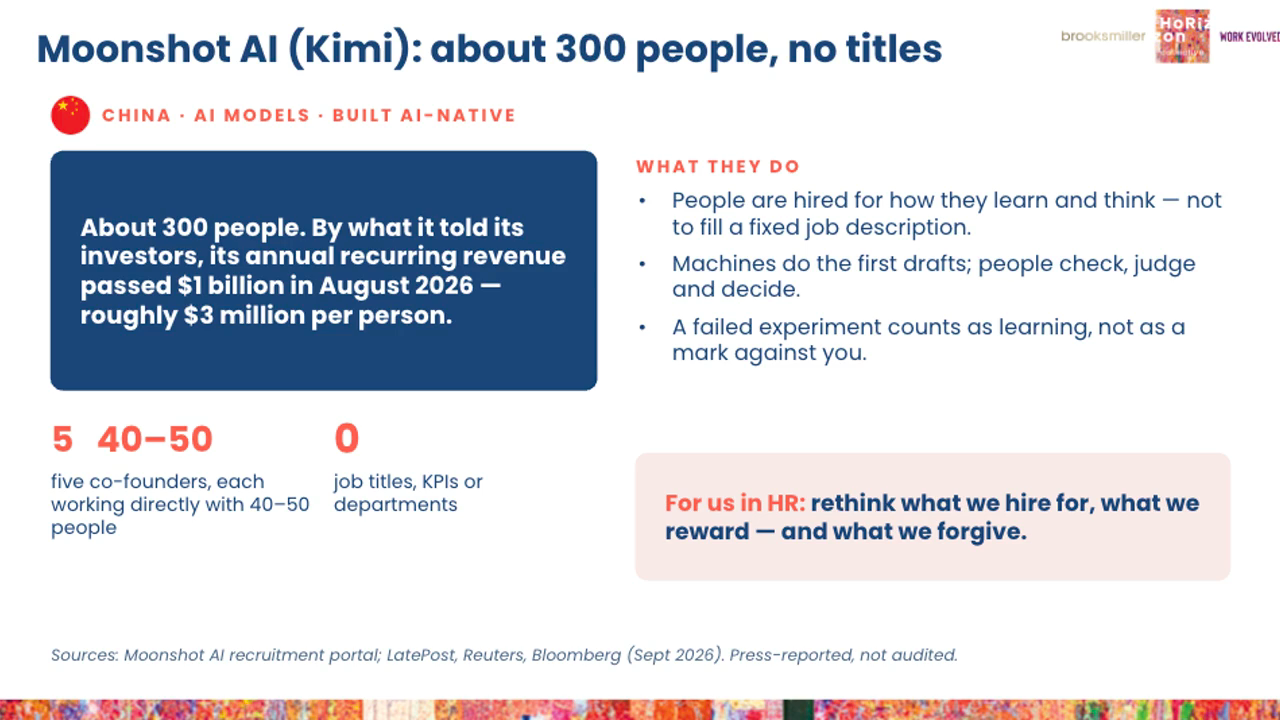
Moonshot AI, the Beijing maker of the Kimi models, has about 300 people, no job titles and no departments. By what it told its investors, its annual recurring revenue passed $1 billion in August 2026 — roughly $3 million per person.
The numbers first — because they earn the right to the argument
The climb was steep and recent. In early March, by press reports, recurring revenue was a little over $100 million. By April it had passed $200 million; by mid-June, roughly $300 million. Then came Kimi K3 — at release the largest open-weight model ever published, with 2.8 trillion parameters and a context window of about a million tokens — and by August the run rate had passed $1 billion. Roughly tenfold in five months, and the catalyst was a model release rather than a sales campaign.
For scale, a very good software company makes $200,000 to $250,000 per person. Even counting all 401 people credited on the K3 technical report, Moonshot is at about $2.5 million. On this measure it is not a little better than normal. It is a different animal.
Two cautions belong beside the number. It is what Moonshot told its investors, first reported by Bloomberg on 11 September, and it stays unaudited until a Hong Kong prospectus is published. No margins have been disclosed at all. And “ARR” is doing quiet work: it can mean annual recurring revenue from subscriptions, or an annual run rate extrapolated from a recent month and including API and project fees. Moonshot has not said which one it means.
The market has priced it anyway. Zhipu, already listed in Hong Kong, trades at roughly 42 times the $1.6 billion of recurring revenue it disclosed in August. MiniMax, also listed, is around 19 times its $800 million. Moonshot’s last private round was reported at a $50 billion pre-money valuation — about 167 times its last publicly verifiable figure of $300 million.
Impressive. Also not the point.
The point is where the work went
Three facts explain the ratio, and none of them is about working harder. More than 70 percent of revenue reportedly comes from API and enterprise use rather than consumer subscriptions, so Moonshot is paid when someone else’s software calls its model. It distributes through established Chinese IT-services partners rather than building an enterprise sales force of its own. And the customer conversation — integration, permissions, audit, explainability — is handled by whoever installed it.
Put those together and the mechanism appears. My book calls it the Exported Deployment Tax. Landing AI inside a real organisation takes enormous human work: integration, permissions, audit, change, training. That work never disappears. It is paid inside the company, as Sierra pays it. It is invoiced to the customer. It is built into new internal roles. Or it is exported, to partners, channels and developers — which is what Moonshot does.
Which means revenue per employee does not measure how good an organisation’s design is. It measures where the organisation drew its own boundary. This is Ronald Coase’s question — why do firms exist, and where do they stop? — and it carries a sting. A company that exports its deployment work exports its accountability with it. The partner who installed the model is the one who explains the failure.
And the tax is beginning to come home. As Moonshot shifts toward large enterprise customers, it has assembled a team of engineers to help clients deploy its models. That is the predictable pattern: the closer a company gets to the customer’s outcome, the more of the deployment work it must carry itself. If its headcount grows faster than its first years suggest, that will be a sign of enterprise success, not a failure of the model.
What the number hides
Within weeks of K3, how Moonshot built its models became the dominant story about the company. In July the White House science adviser alleged that it had distilled a rival’s model and trained K3 on export-banned hardware. In September Anthropic alleged that Moonshot had routed user requests through its Claude models to harvest the outputs. On 8 September a joint advisory attributed to the NSA, the FBI and CISA alleged that one competitor’s model had been used to train Kimi K3 and another’s to train K2. On 1 October OpenAI said it had disrupted a campaign of roughly 16,000 extraction requests over two days in July, tied to a cluster it associates with Moonshot.
A British security firm says it warned Moonshot on 27 July that two Kimi models could be pushed past their safety controls, and heard nothing until a journalist asked six weeks later. Moonshot denies the distillation claims, saying K3’s gains came from original architecture, and China’s foreign ministry has rejected the accusations as unfounded. I am not in a position to judge any of it, and this case does not rest on it.
But the six-week silence is legible on its own. For a model maker, the list of things its machines must never do includes how its own models may be trained and what they must refuse to say — and few labs publish that list. The design that makes Moonshot fast is the same design that makes governance easy to postpone.
The uncomfortable half
Moonshot’s organisation explains its speed, and the deliberate absence of a deployment workforce. It does not explain the revenue, which is the model itself — and compute and capital are doing work that the talent principles will otherwise be credited with. In July the company had to pause new subscriptions because demand neared the limits of its clusters.
So the honest reading is this. Moonshot proves that intelligence can be manufactured by very few people. It does not prove that intelligence can be deployed by very few. Only the first claim is supported by three hundred people and a billion dollars — and the second is the one your organisation would actually have to make.
The transferable lesson is not the ratio. It is the question underneath it. The people side of this case — five hiring trade-offs, and the one rule about failed experiments — is the companion piece: What Happens When an AI Company Runs on Judgment Instead of Meetings?
Design the machine to be AI-first, so that the people can be more human.
One question to hold this week: before you admire anyone’s revenue per employee, which work has that company handed to someone else — and which of yours could you responsibly hand over?
Sources: Moonshot AI’s reported revenue trajectory and the Kimi K3 release (16 July 2026); Bloomberg (11 September 2026) for the $1 billion figure, which remains unaudited; LatePost (2 September 2026) for the reporting basis of “ARR” and the Hong Kong filing; 21st Century Business Herald, Securities Times and Yicai for the funding, valuation and peer-multiple figures; the K3 licence terms and Reuters (August 2026) for the cloud revenue-share talks; BBC reporting and Mindgard’s account for the safety-disclosure timeline; OpenAI’s disclosure (1 October 2026) and the 8 September joint advisory attributed to the NSA, FBI and CISA. Framework reference: Chunfeng “Breeze” Dong and Peng Wang, The Living Organization — the AI-Enabled Living System, its five pillars and the Exported Deployment Tax. Figures are company-reported and unaudited; allegations are not findings. No affiliation with Moonshot AI.
Mirrored from AI-Native, Deeply Human, the newsletter by Chunfeng “Breeze” Dong. Get new essays by email.