🎧 Prefer to listen? The full narration of this essay is free — listen here.
Prefer to read? The full case follows.
Most AI transformation stories are procurement stories. A company buys licences, runs a pilot, reports a productivity number, and schedules a steering committee. Haier’s story started twenty years earlier, with a decision that had nothing to do with software.
The numbers first — because they earn the right to the argument
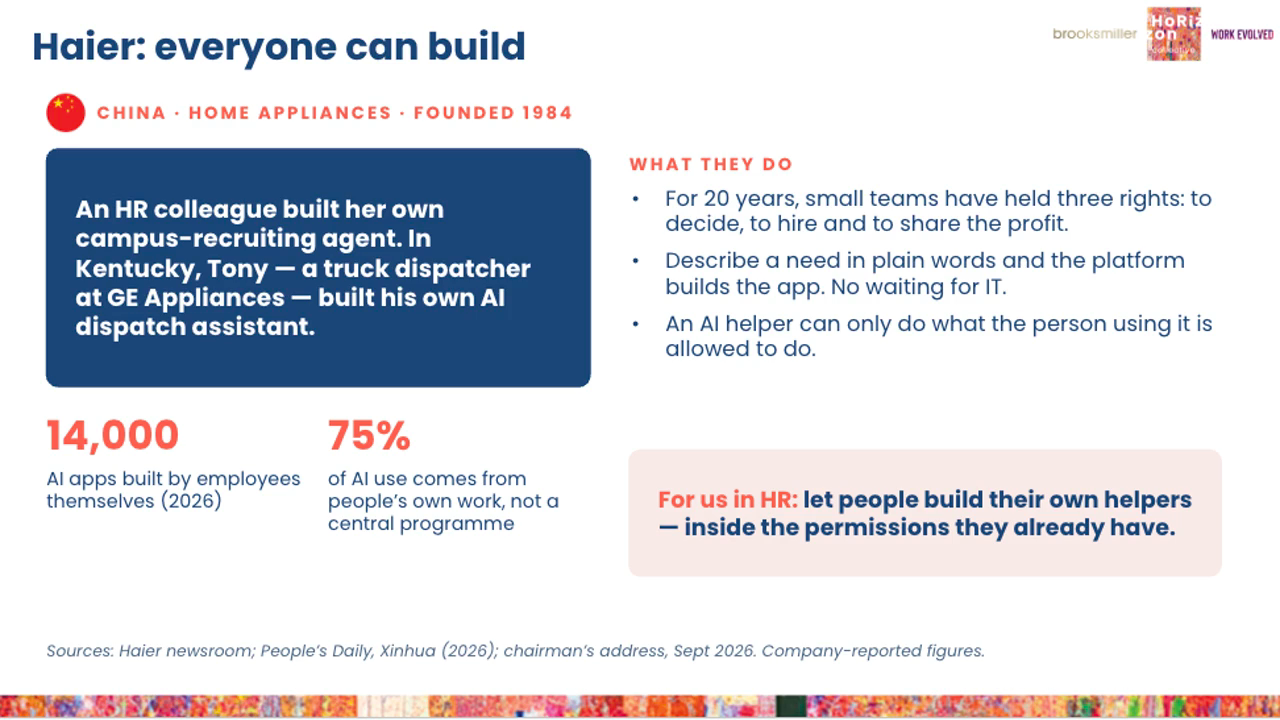
By the company’s account, more than 60,000 Haier Smart Home employees now work with Zhixiaoneng, its platform for what Haier calls digital employees — agents entered in the company directory as members of staff. They have built over 14,000 AI applications themselves, up from about 5,100 in June. Around three-quarters of token consumption comes from ordinary employees’ own work rather than from a central programme.
You can see it on real desks. Replenishment analysis went from an hour to five minutes. Process planners who once spent hours on a single document now review an AI draft, with accuracy reportedly up by more than a fifth. At GE Appliances in Kentucky, a truck dispatcher named Tony built his own AI dispatch assistant that sharply raised shipping efficiency — and within a year, the chairman says, more than 5,000 agents and assistants had emerged there.
The results are strong: research and development cycles about 30 percent shorter, manufacturing efficiency up 20 percent, and fourteen World Economic Forum lighthouse sites — more than any other manufacturer. Two cautions keep it honest: the most-quoted quality figures belong to one factory in Qingdao, not the group; and the first half of 2026 was a down half, with revenue down 2.8 percent to ¥152.1 billion. An AI-native organisation does not repeal the business cycle.
Impressive. Also not the point.
The point is that Haier didn’t create this capability. It released it.
Everywhere else the sequence runs: buy the tools, leave the hierarchy standing, then wonder why adoption stalls. That is the Adaptation Gap in its purest form — a jet engine strapped to a horse-drawn carriage.
Haier dismantled its carriage in 2005. Under RenDanHeYi, the model that broke the company into thousands of micro-enterprises, every unit holds three rights: to decide, to hire, and to share the profit it generates. A team may act without asking, and keep the proceeds — or fail and bear the cost. The first is a permission. The second is a property right. Permissions are administered; property defends itself. That looks like a difference of degree. It is not. Granted authority erodes when the grantor loses interest. Owned authority compounds.
There is a natural experiment hidden here. Zhang Ruimin stepped back in November 2021, six months after ByteDance’s founder left its top job — both lost their founding philosopher the same year. Five years on, ByteDance has rebuilt a conventional executive layer; Haier’s structure survived intact. One founder’s idea needed a founder; the other did not. That is not a fact about the two men, but about where each put the authority before he left.
Then came the unfashionable work. Since 2014 Haier has been building H-work, an internal platform that brings the capabilities, permissions and interfaces of research, production, supply, sales and service into one place — the work of making an organisation legible to itself. Around it sit two tools with lovely names: 一念, Yinian, “a single thought,” where an employee describes a need in plain language and receives a working application, and 无界, Wujie, “without boundaries,” for deeper enterprise workflows. When agents arrived, they had somewhere to attach.
That is Distributed Authority, and it is why the number is 14,000 rather than 40. Authority cannot be installed with a licence purchase; it accumulates. What Haier wrote off instead was the largest line item in the cost of coordinating by permission — the queue outside the IT department.
And here is the mechanism, stated plainly
An employee types eight words into the platform: help me check an order. The system finds the order, then keeps going — is it overdue, does it need expediting? Ask about raw materials and it compares inventory, flags a shortage, proposes a replenishment.
Now the part that matters. A colleague in procurement and a colleague in marketing can type exactly the same eight words and reach different systems. Haier taught its AI not only what each interface does, but who may call it. An agent’s reach is bounded by the permissions of the person who invoked it. It inherits authority. It cannot borrow more.
In my book I call this the Delegation Ceiling: an organisation cannot delegate to machines an authority it never distributed to humans. Where decisions sit at the top, agents will sit at the top too — and every new agent becomes a negotiation with the centre. Haier says yes in an afternoon because the answer was settled years ago.
Haier is no longer the only example. In the same twelve months, Alibaba ruled that an agent must inherit the employee’s original permissions; ByteDance’s workplace agent inherits its platform’s permissions; Lenovo gives every agent a named human owner. Four of the largest companies in China arrived at permission inheritance at once — which suggests the mechanism travels, and that the organisations which struggle will be those whose human decision rights were never clear enough to inherit.
The hard part is what comes after 14,000
This is where the fifth pillar — Human–Agent Governance — does the real work, and where Haier is half finished.
On the strong side, digital employees sit in the directory, with explicit boundaries on which actions an agent may take alone and which need human confirmation, and security sandboxes were built before go-live in a thirty-person, twenty-day effort.
On the open side, nobody has said whether those 14,000 employee-built applications are inventoried, versioned and inheritable. Fourteen thousand ungoverned applications is how organisational drift begins. And across thousands of self-managing units, each carrying its own agents and its own profit and loss, there is no visible guardrail against local optimisation at machine speed.
So the honest question is not whether Haier has good controls. It plainly does. It is whether a governance model built for a few dozen centrally-built agents stretches to an estate of fourteen thousand built at the edge, by people whose next iteration no committee will see.
The uncomfortable half
Agency is high. But whether moving from author to reviewer enriches a person’s work or quietly deskills it has not been measured by Haier or anyone else. That makes Human Wholeness unproven.
The weaker pillar is purpose. Micro-enterprises are coordinated by internal market contracts: win the user or lose the budget. That is a superb engine for distributed authority — but a contract is not a purpose. It cannot tell thousands of self-optimising units, and now their agents, what is not for sale. Haier’s chairman put it as a question at the company’s September 2026 forum: technology is leaping exponentially while organisations crawl linearly. His answer was dignity: everyone can become “their own CEO.” Whether that coordinates anything beyond the contract is what this case cannot yet answer.
Design the machine to be AI-first, so that the people can be more human.
One question to hold this week: if everyone in your organisation could build an AI agent tomorrow, whose permissions would it inherit?
Sources: Haier’s corporate newsroom (June 2026); People’s Daily and Xinhua on the 60,000-user and 14,000-application figures; 36Kr (June 2026); chairman Zhou Yunjie’s address at Haier’s September 2026 forum; Haier Smart Home interim results (27 August 2026); the World Economic Forum’s Global Lighthouse Network. Framework reference: Chunfeng “Breeze” Dong and Peng Wang, The Living Organization: The New Operating Model for Flourishing in the AI-Native Era — the AI-Enabled Living System, its five pillars, the Delegation Ceiling and the Distrust Tax. Figures are company-reported. Haier is not a client or affiliate.
Mirrored from AI-Native, Deeply Human, the newsletter by Chunfeng “Breeze” Dong. Get new essays by email.