🎧 Prefer to listen? The full narration of this essay is free — listen here.
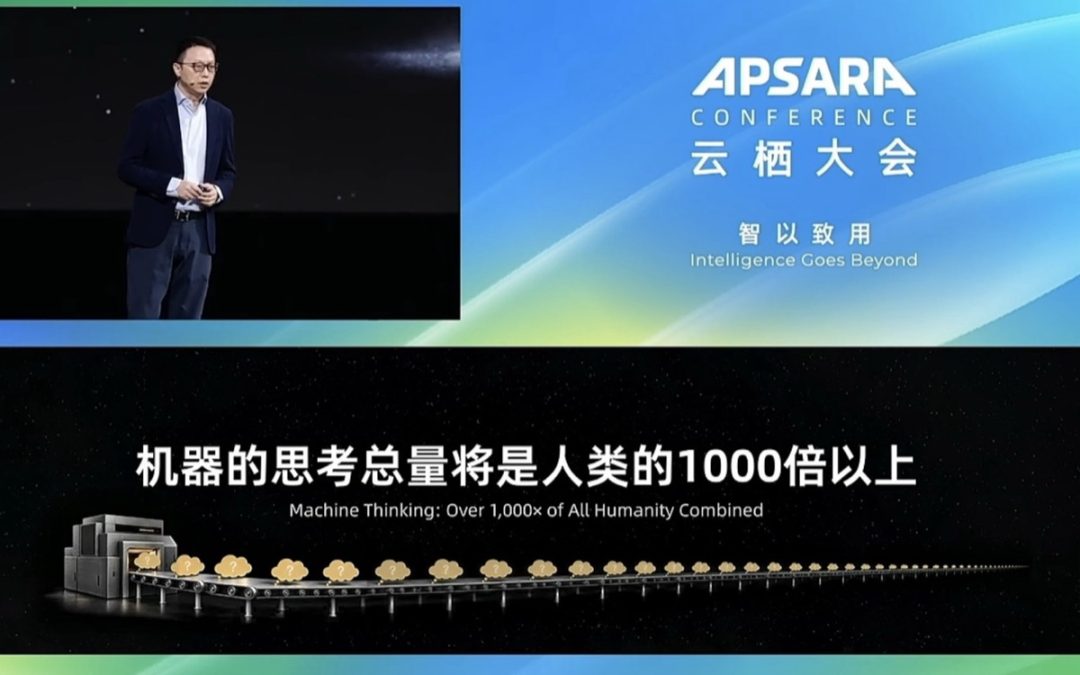
On 22 September, at the Yunqi Conference in Hangzhou, Wu Yongming — chief executive of Alibaba Group — did something executives rarely do. He put a number on the end of the world as we know it, and then he showed the receipt.
Two claims, delivered plainly. First: the total volume of thinking supplied by machines will exceed the total volume supplied by humans by more than a thousand times. By his arithmetic, machine thinking sits under 3% of ours today. Second: the defining product of this era has not been invented yet.
Most keynote claims of that size are rhetoric. These arrived with a shopping list.
Alibaba is releasing a new chip — Zhenwu V900 — at three times the performance of its predecessor, with a single cluster scalable to 500,000 cards. Its in-house M890 super-node already runs inference on models above two trillion parameters, a capability he says very few companies in the world have. Its Qwen team plans a model at the 5–10 trillion parameter scale. And the company has committed to more than 20 gigawatts of operated global data-centre capacity by 2032.
He frames all of it as three foundations — AI models, AI chips, AI cloud — and the metaphor he reaches for is the one that matters. If tokens are the electricity of this age, chips are the generators and the cloud is the grid. His point is that we never notice the grid. We notice the socket. Anywhere you plug in, power comes. He wants machine intelligence to feel like that: every device, connected, thinking available on demand, the whole remarkable apparatus invisible behind it.
You do not commit to twenty gigawatts on a forecast. You commit because you have stopped expecting the demand curve to bend.
Impressive. Also not the point.
Why this is an organizational claim wearing technical clothes
The interesting part of the keynote is not the hardware. It is the reason he gives for needing it.
The binding constraint on thinking has always been human. Training a top scientist takes decades, plus talent, plus luck — which leaves whole fields permanently starved of attention. His example is progeria in newborns: a few dozen new cases a year worldwide, a few hundred recorded patients, and no commercial logic that would make any company spend decades developing a drug for a few hundred people. Once AI reaches professional research capability, and compute is cheap enough, he says every niche field can organise millions of agents to run experiments in parallel. Top-tier thinking stops being a luxury and becomes a commodity.
Sit with that word. Not capability. Not tooling. Commodity. Something you buy by the unit, the way you buy electricity, and then stop thinking about.
Now put the two claims together, and the consequence lands somewhere unexpected. If thinking becomes a utility, thinking stops being a differentiator. The advantage moves entirely to what you build on top of cheap thinking. That is not a technology question. It is a work-design question, a decision-rights question, an organizational-design question — and it is the question my own profession has been slow to answer.
This is the Adaptation Gap, and it has never been wider. The technology is compounding exponentially while the organizations meant to absorb it change in linear steps. The infrastructure arrives in gigawatts. The redesign arrives in steering committees. That mismatch — a jet engine strapped to a horse-drawn carriage — is where a great deal of AI investment quietly dies.
The part nobody budgets for
Here is where the keynote becomes genuinely useful, because Wu arrives at the same wall from the opposite direction.
He is building an unlimited supply of thinking. But you can deploy an unlimited supply of thinking into an organization with no capacity to receive it, and the result is not transformation. It is noise. We already have the evidence: the pilots that go nowhere, the tools that get adopted and change nothing, the individual productivity gains that never appear in the organizational numbers.
The capacity to receive is a governance question, and most organizations have not made the decision. It comes down to three lists that almost nobody writes down: what an agent may do alone, what it may do with review, and what it may never do. That is the Machine Governance Matrix, and it is the pillar of the AI-Enabled Living System that gets skipped most often. Not because it is hard to write. Because writing it means an executive has to say out loud where human judgement is non-negotiable — and that is a statement about authority, not about software.
Skip it and you get the pattern we all recognise by now: enthusiastic adoption, diffuse accountability, and a quiet retreat the first time an agent does something embarrassing.
The fork in the road
Wu’s closing line is the one worth carrying home:
“Leave the onerous tasks to the machines. Leave time, creativity, and the capacity to feel beautiful things to humanity.”
I have been writing a version of that sentence for years. What is new is hearing it from the person building one of the largest thinking-supply machines in the world, and funding it at a scale that assumes the sentence is true.
But notice what his own history lesson requires. Machine power took over physical labour and humans did not stop moving — we invented football, basketball, the modern Olympics, the World Cup, the NBA. That is true, and it is genuinely encouraging. It is also the slow version of the story. Those new forms of effort did not appear automatically. They appeared because societies reorganised around freed capacity — which took decades, and was frequently hard for the people living through it. Nothing about that transition was designed in advance, and that is exactly the difference available to us now: we can design it, if we choose to.
At organizational scale, the fast version is available to us. It requires a decision that has nothing to do with technology: what is the freed time for? If every hour saved is immediately refilled with more of the same work, people learn within a quarter that efficiency is a trap, and they withdraw. If it becomes better thinking, closer customer contact, real craft, actual recovery — they lean in. Efficiency without a stated purpose reads as extraction. Wu’s version of the same point is that the whole exercise is only meaningful if the time goes somewhere worth going.
That is a values decision wearing a productivity costume. And it is yours to make, not your vendor’s.
Design the machine to be AI-first
The scarce resource is not intelligence. It has not been for a while, and on Wu’s own numbers it will not be by 2032.
The scarce resource is an organization capable of deciding what intelligence is for.
That is not a problem twenty gigawatts of data centre can solve. It is not a problem a chip can solve. It is the problem sitting on the desks of everyone in L&D, in HR, in organization development — and on every executive team that has an AI strategy and no work-design strategy.
Design the machine to be AI-first, so that the people can be more human. That sentence was a design principle a year ago. Wu has just given it a twenty-gigawatt budget on Alibaba’s behalf.
The question to sit with: if thinking costs almost nothing by 2032, what will your organization be for?
Sources
-
Keynote by Wu Yongming (Eddie Wu), CEO of Alibaba Group, at the Yunqi Conference, Hangzhou, 22 September 2026. Alibaba has published an official transcript of the address.
-
Figures and claims cited above — the 1,000× ratio, the 99.9% share, the sub-3% baseline, 3× Zhenwu V900 performance, 500,000 cards per cluster, the 5–10 trillion parameter Qwen target, and 20 GW of operated global data-centre capacity by 2032 — are company-reported and company-forecast, not independently verified results. Treat the directional argument as the claim; treat the numbers as Alibaba’s own.
-
The Adaptation Gap, the Machine Governance Matrix and the AI-Enabled Living System are frameworks from The Living Organization (2026), which I co-authored with Peng Wang.
-
The progeria example, the Pearl Street Station comparison, the “tokens are electricity, chips are generators, cloud is the grid” framing and the post-Industrial physical-sport argument are the speaker’s, and are reproduced here as his reasoning rather than as settled history.
-
Organizational-design commentary, and any errors, are mine. I have no affiliation with Alibaba or Alibaba Cloud.
Mirrored from AI-Native, Deeply Human, the newsletter by Chunfeng “Breeze” Dong. Get new essays by email.