Originally published on AI-Native, Deeply Human on Substack.
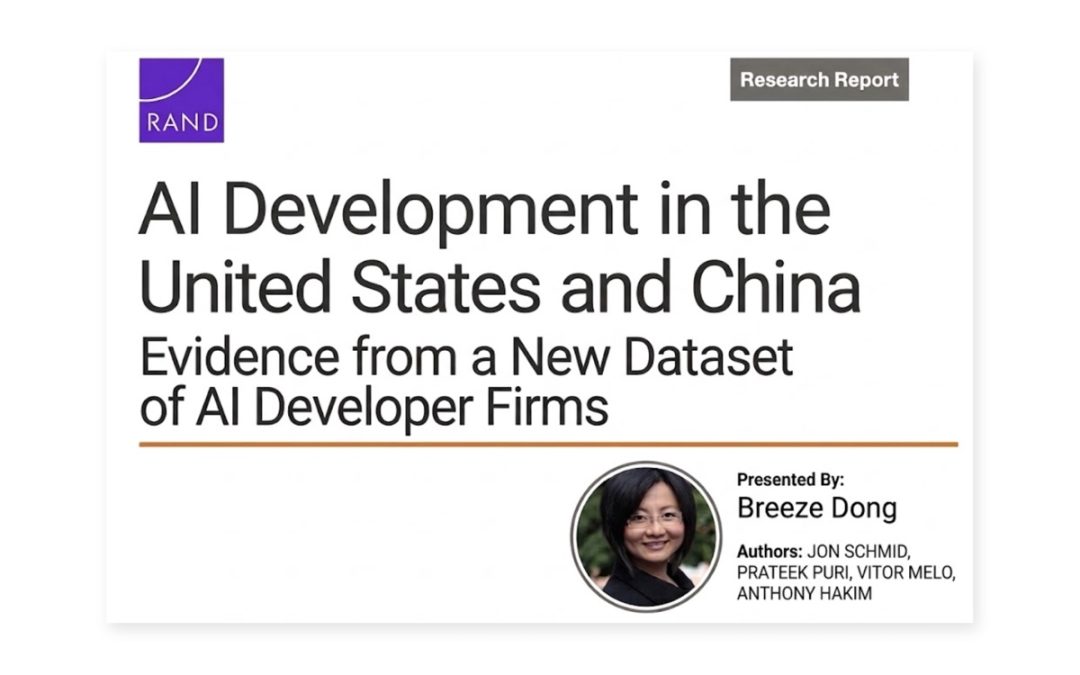
RAND, the think tank that has advised the US government for seventy years, just did something very unglamorous. Instead of reading national AI plans or watching the five famous labs, they pulled every organisation in the United States and China that showed any sign of building AI — 26,629 of them — and filtered ruthlessly. Companies that merely use AI were thrown out. Wrappers around somebody else’s API were thrown out. Only firms that train their own models survived. That left 1,181 companies: 743 American, 438 Chinese. Then they tagged every single one across nine dimensions — architecture, learning method, business model, industry, physical form — and compared the two piles.
I read the report expecting a race. What I found was a pair of twins.
Eighty percent identical
On almost every dimension the two ecosystems look like siblings. Transformer architecture leads in both: 28 percent of US firms, 27 percent of Chinese firms. Firms that pretrain a foundation model from scratch: 19 percent on each side. Firms whose business is selling model access through an API — the OpenAI, Anthropic, DeepSeek, Zhipu slice that fills the news — about 10 percent in each country.
Sit with that number. The names we have obsessed over for two years are one-tenth of the ecosystem. The other ninety percent are quietly building products, and their customers do not care whose model runs underneath, as long as the thing does the job.
The popular story that "America bet everything on one road while China spreads its bets" also collapses. China’s plans talk loudly about neuromorphic chips and post-transformer architectures. RAND looked for them in the firm data and found no evidence that Chinese companies pursue those paths any more than American ones. Both ecosystems are transformer-led, with nearly identical tails.
So where is the difference?
The one thing that differs: the body
Sixty-one percent of US AI developers are software-only. In China the figure is 26 percent.
Humanoid-robot firms: 2 percent of the US sample, 12 percent of the Chinese — more than five times. Ground robots and quadrupeds: 16 versus 24 percent. Autonomous vehicles: 7 versus 14. Flip to industries and the same pattern appears. Manufacturing: 15 percent of US firms, 30 percent of Chinese. Transportation: 15 versus 26. Energy: 6 versus 12. Now the other direction. Health care and life sciences: 28 percent of US firms, 17 percent of Chinese. Scientific research: 10 versus 5. Cybersecurity: 7 versus 3.
My favourite detail is reinforcement learning. Exactly 19 percent of firms on each side use it — identical. But when RAND read the underlying documents, the same word meant different homework. American firms use RL to shape language models — RLHF, preference tuning, making the model speak more pleasingly. Chinese firms use RL to teach a robot to walk, a car to turn, a production line to adjust its parameters. One trains the mouth. The other trains the legs.
Same brain. America gave it a keyboard. China gave it hands and feet.
A fair caveat, which RAND states itself: Chinese firms disclose less, so their counts are lower bounds and the gap is probably smaller in magnitude than the headline numbers. But the direction is real, and it shows up across independent dimensions — form factor, industry, data modality, learning paradigm — all pointing the same way.
Why? Not the reason you think
The lazy explanation is policy. Beijing named "embodied AI" a national priority in 2025, so embodied AI grew. But that explanation has a hole. The same plans also named neuromorphic computing and new architectures, and those did not grow. Policy can give money, orders and pilot scenarios. It cannot tell an engineer which architecture to write code in on Monday morning.
The commentator whose reading of this report I listened to offered a better explanation, and it has been rattling around my head since: water flows downhill; AI flows toward whatever is most expensive.
What is the most expensive thing in the American economy? An expert’s hour. A doctor reading a case file. A security engineer staring at a screen. So American AI floods into health care, research and cybersecurity — knowledge work, delivered as software. What is the biggest cost pool in China? The production line, the delivery fleet, the power grid. So Chinese AI floods into manufacturing, transport and energy — and has to grow a body to get there.
The map confirms it. Of 743 American firms, 350 sit in California, clustered around Stanford and Berkeley. Beijing leads China with 159, mostly research-heavy. But Guangdong, Zhejiang and Jiangsu together hold 145 firms — the densest factory belt on earth. American AI grows next to universities. Chinese AI grows next to factories. It is not that one side had better vision. The soil is different, so the plants are different.
The hedge — and its premium
RAND’s closing thought is careful but pointed: if the path to more powerful AI eventually runs through robotics, world models and learning in physical environments, then China’s embodied portfolio is a hedge the US ecosystem simply does not have.
Anyone who has invested knows a hedge is not free. You pay a premium. China is paying it now: embodied-AI financing in the first half of 2026 reached roughly 93.5 billion yuan, five times the same period last year. Humanoid output was around 20,000 units last year and the industry ministry wants six figures this year. There are more than 140 whole-robot makers, and the national planning commission has already warned against everyone piling in. As the commentator put it, the bubble will be in the legs, not the hands: robots that do backflips trend on social media; robots that turn a screw get onto the production line.
America pays a premium too. Hundreds of billions of dollars in compute are betting on one proposition — that intelligence living inside a screen is enough. What if it is not?
Which is why "who is winning the AI race?" is the wrong question. There is no finish line. Two ecosystems are each flowing toward their own most expensive thing.
What this means for the rest of us
I work with organisations, not nations, and the same physics applies.
Stop watching the ten percent. Your advantage will not come from which model you license. Eighty percent of the intelligence is now a commodity. Your edge is the body you give it — your workflows, your data, your physical and social context. Same brain; what are you attaching it to?
Find your most expensive hour. AI will flow there whether you plan it or not. In a hospital it is the clinician’s attention. In a factory it is downtime. In a professional-services firm it is the senior partner’s judgement. Locate that hour and design the flow deliberately, instead of discovering it when the water has already arrived.
Strategy decks do not govern Monday. Beijing could not make its engineers build neuromorphic chips by writing it into a plan. Your AI strategy will not make a team change how it works by writing it into a slide. What governs Monday is soil: incentives, permission, the daily cost of trying something. Change the soil and the plants follow.
Water flows downhill. AI flows toward what is expensive. The only question worth asking is: what is expensive in your world — and are you giving the brain a body there?
Prefer to listen? The narrated audio edition of this essay is free — listen here.