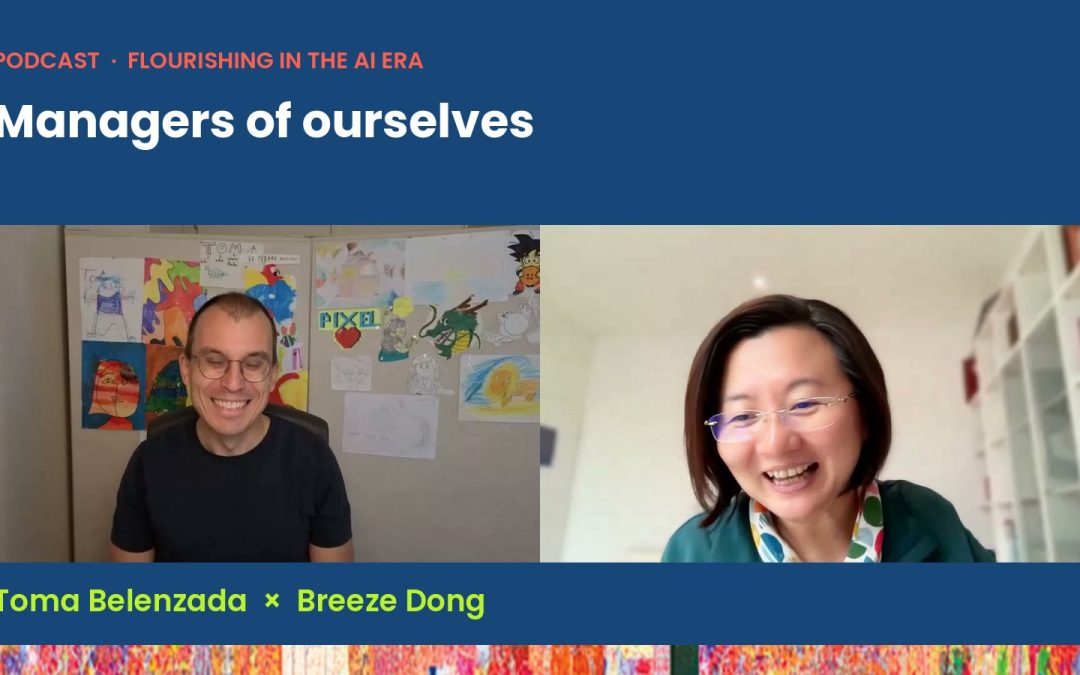
Watch on YouTube: AI Agents and Burnout: Managers of Ourselves, with Toma Belenzada
“One day we all woke up in the morning and we became managers of ourselves.”
Toma Belenzada said it almost in passing. I laughed, and then I went quiet, because it described my last six months exactly.
After two decades in tech, much of it in big tech, Toma pivoted to coaching people who were once like him. We met through a friend, and our conversation moved between two things I care about: what AI agents do to our days, and what they do to our nervous systems.
Four stages I recognised in myself
I shared with Toma the pattern I have noticed in my own work with AI. First comes the stimulus: something new, and it feels like magic. Then the hype: I can build so much, so I take on more and more. Then brain fry, which I have definitely lived. And then, I hope, flow.
Building is so easy these days. But the risk of doing the wrong thing at machine speed is just as easy.
The load moves to the body
Toma’s frame helped me see why the third stage arrives so fast. Five, ten or a hundred agents are always available, and they go super fast.
“It quietly shifts the load onto the nervous system.”
He compared it to a casino. You type a prompt, you wait, and sometimes the reward comes. There is dopamine and adrenaline in it. And when an agent frustrates you and you switch to the next one, you don’t arrive fresh. You carry an attention and emotional residue with you.
Our autopilot was built for an older environment, he said, where the rules of the game were clearer. Deadlines, grinding, pushing through. That habit doesn’t fit a world where the only message is:
“Now the only thing we’re asking you is: do more.”
This is also a design question
Here I wanted to add the organisational lens. Caring for our own nervous system matters. But leaders could also choose much more conscious organisational design, so that AI doesn’t simply add cognitive load to people who already carry too much. This is the heart of what I wrote about in The Living Organization: a living system notices when its people are overloaded.
Give AI what drains you
Toma’s advice for individuals was refreshingly simple. Notice what you like doing, and what you don’t like but still have to do.
“Give everything that you don’t like to AI, so you get more space for what you like and your purpose.”
He added one firm boundary. Automate the back office first, the things the customer never sees. Wherever AI speaks in your name, “you are accountable for each word that it says.”
The gold mine we already sit on
I closed with something from my own practice. In Buddhism there is a saying that we all have Buddha nature. We are sitting on a gold mine, yet we search everywhere else for something precious.
Perhaps that is the quiet invitation of this moment. AI can carry more of our load. It cannot give us presence. That part is ours.
A few threads I’m holding
-
Notice your stage. Hype and brain fry feel productive until they don’t.
-
Watch the residue. Switching agents is not free for the person switching.
-
Design for nervous systems, not just output.
-
Own your rest. And own every word AI writes for you.
What would you hand to AI, so you have more space for what you love?
The full conversation is in the video above, with subtitles. You can also listen to it as Episode 9 of Flourishing in the AI Era. I’d love to hear which stage you are in.
Breeze Dong is the author of The Living Organization and writes AI-Native, Deeply Human. Toma Belenzada is a coach for tech experts and leaders, based in Berlin. His views are his own.
Chunfeng “Breeze” Dong is an organizational development leader and executive coach (ICF PCC, CPCC) working on AI-native organization design. She has spent over twenty years in global enterprises, from strategy at Roland Berger to organizational development at Siemens, ABB and Roche. She is the author of A Soulful Transition and co-author, with Peng Wang, of The Living Organization. More: AI-native organization design · LinkedIn · Substack