McKinsey calls it the agentic organization. BCG calls the leaders AI front-runners. Deloitte writes about the AI-native enterprise. Gartner, the AI-shaped organization.
Four firms, four brand names. Read the reports side by side and they describe the same animal from four sides: AI does not rewire the job. It rewires the organization. They agree on four things, and stay silent on one.
AI-native is an operating model, not a tool count
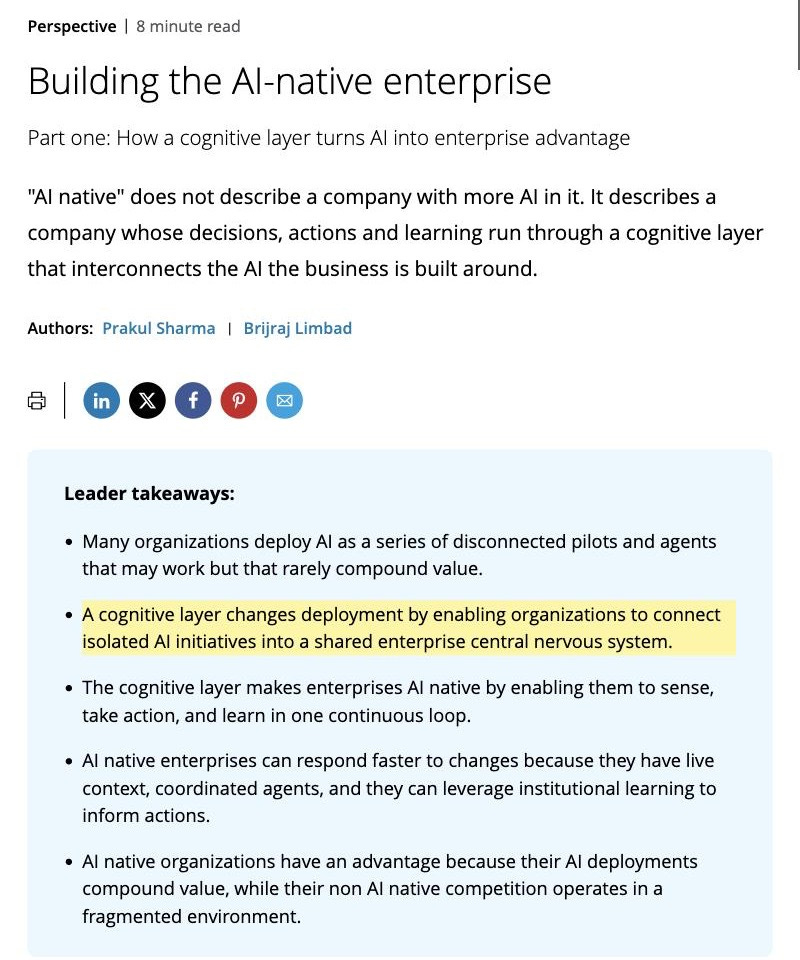
The first point of agreement is the most important. None of the four defines AI-native by how much AI a company uses. Deloitte says it plainly: AI native “does not describe a company with more AI in it.” It describes a company whose decisions, actions and learning run through a shared layer of intelligence.
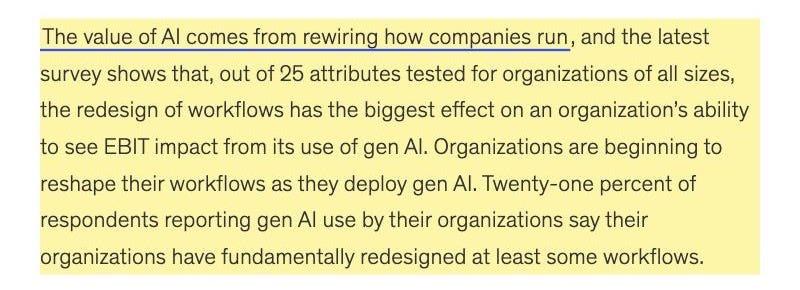
BCG makes the same point from the field. Its front-runners do not necessarily have record AI usage. What they have changed is how work is organized. McKinsey’s own survey data shows how rare that still is. Out of 25 organizational attributes it tested, redesigning workflows had the biggest effect on whether companies saw bottom-line impact from gen AI. Yet only 21% of companies using gen AI had fundamentally redesigned even some workflows.
That gap, between buying intelligence and reorganizing around it, is where the real work of AI transformation sits.
Design starts from value, not from jobs
The second agreement changes the first question an OD team asks. The old question was: how many people does this role need? The new one is: what work creates value here, and who or what should do it?
Gartner frames it as a shift from who does the work to what work creates value. BCG found that in more than half of its 50-plus front-runners, leaders set the direction while individuals and teams own the outcomes. People stay accountable for the “what” and gain freedom over the “how”. Gartner adds a timeline: by 2028, organizations that make continuous work redesign a core capability will be twice as likely to sustain AI-driven transformation.
Jobs become the result of work design, not its starting point.
Decision rights follow reversibility, not seniority
This is the agreement I find most practical, and the one most often missed. AI speeds up information. If every decision still climbs the same ladder, the speed is lost in the approval queue.
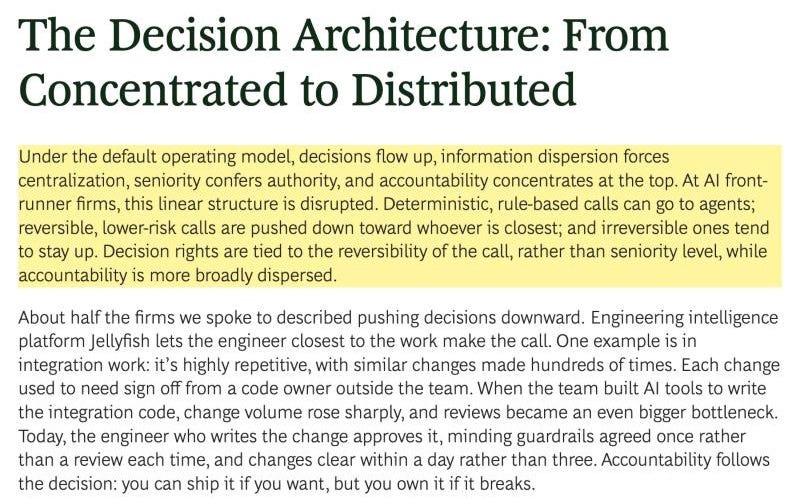
BCG describes a simple rule from the front-runners. Rule-based calls go to agents. Reversible, lower-risk calls move to whoever is closest to the work. Irreversible ones stay up. About half the firms pushed decisions downward, and just under two-thirds had heavily reduced sign-offs. At one engineering platform, changes now clear in a day instead of three, because the engineer who writes the change approves it within guardrails agreed once.
McKinsey reaches the same place from governance: continuous controls instead of periodic reviews, with humans keeping final accountability. In The Living Organization we call these two pillars Distributed Authority and Human–Agent Governance. They only work together. Autonomy without guardrails is chaos. Guardrails without autonomy are just another layer of bureaucracy.
New human roles are already appearing
None of the four describes a company without people. All four describe people doing different work.
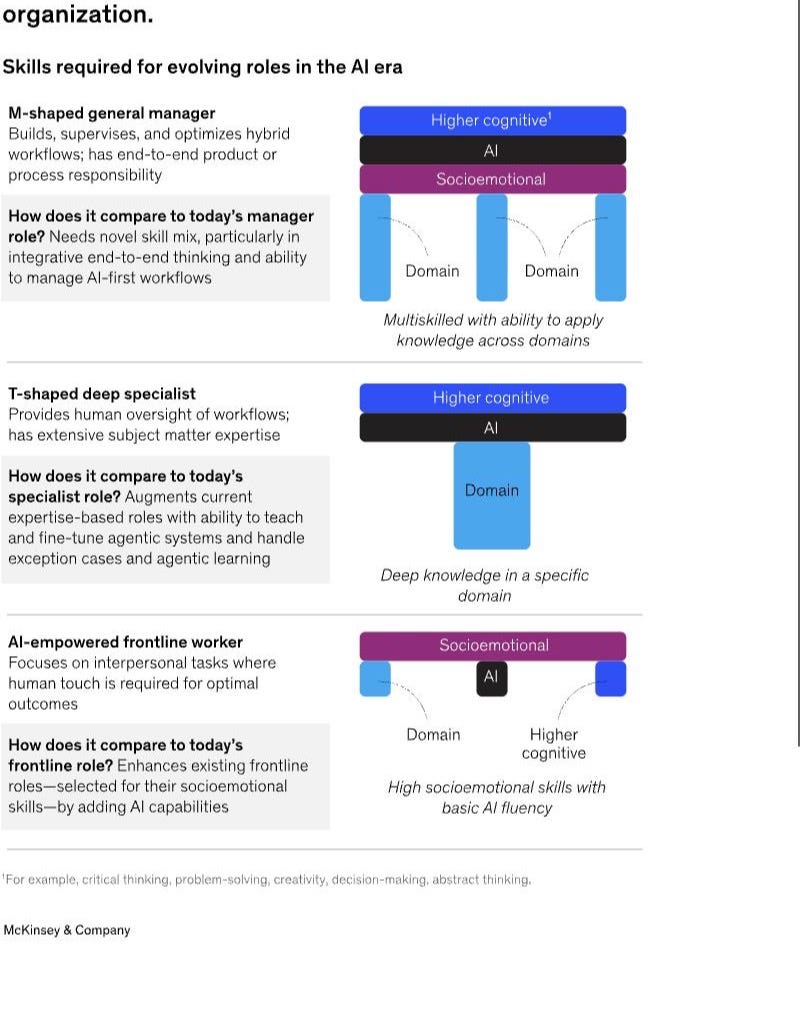
McKinsey sketches three profiles: the M-shaped manager who supervises hybrid workflows end to end, the T-shaped specialist who teaches and corrects agents, and the AI-empowered frontline worker valued for human touch. BCG’s interviews name five roles it saw again and again: citizen builders, workflow designers, AI guardians, domain anchors who turn expert knowledge into something agents can use, and agent shepherds who decide what agents may access and when to switch them off.
For HR, this is the real agenda for 2027. These roles have no job families, no career paths and no pay bands yet.
Where the four differ
Their disagreements are mostly about altitude, not direction. Deloitte works at the level of the organization’s nervous system: shared knowledge, context and learning. McKinsey describes the whole future form of the enterprise. Gartner works on the unit of work and the role. BCG documents management practice that already exists.
Two cautions matter. BCG studied front-runners, so its practices are not today’s average. McKinsey mixes early cases with projections. A few people managing many agents is a signal, not a template.
The silence they share
Here is what I noticed reading all four in one sitting. They redesign work, decisions, roles and knowledge, and almost nothing about the inner life of the people asked to make the shift.
When “machines produce, humans direct and evaluate”, the human job becomes judgment all day long. That is cognitively heavier, not lighter. It needs psychological safety to own a call that might break. It needs a sense of purpose that a value stream alone does not give. In our framework these are Human Wholeness and Evolutionary Purpose, and they are the pillars the consulting reports leave mostly blank.
I don’t read this as a flaw in the research. It is a division of labour. The firms map the machine. Coaches, OD practitioners and leaders have to tend the people inside it.
Where to start on Monday
All four would agree on one thing: don’t start by redrawing the org chart. Start with one value stream.
-
Pick one end-to-end flow, from customer need to delivery.
-
Map the work, then decide what goes to agents, what stays human and where judgment sits.
-
Set decision rights by reversibility, and write the guardrails once.
-
Only then change roles, team shape and how you measure performance.
Two companies can buy the same model and the same platform and get very different results. The difference won’t be the AI. It will be whether they had the courage to reorganize around it, and the care to bring their people along.
Related reading
-
The Living Organization: Five Pillars of an AI-Native Operating Model: the framework this essay uses
-
67% of AI Adoption Blockers Are Organizational, Not Individual: why the bottleneck isn’t the model
-
Why Hierarchy Existed, and Why AI Just Removed the Reason: the history behind decision rights
-
The Org Chart Is the Real AI Strategy: a case from ByteDance
-
The book: The Living Organization, with Peng Wang
Sources: McKinsey, “The agentic organization: Contours of the next paradigm for the AI era” (26 Sep 2025) and “The state of AI: How organizations are rewiring to capture value” (12 Mar 2025); BCG, “How Companies Use AI to Redesign How Work Gets Done” (2026); Deloitte, “Building the AI-native enterprise, Part one: How a cognitive layer turns AI into enterprise advantage” (2026); Gartner, “The AI-Shaped Organization Reimagines Work, Not Jobs” and its 15 Sep 2026 prediction on continuous work redesign, as reported by HR Dive (24 Sep 2026). Screenshots are from the firms’ public web pages, used for commentary with attribution.
Chunfeng “Breeze” Dong is an organizational development leader and executive coach (ICF PCC, CPCC) working on AI-native organization design. She has spent over twenty years in global enterprises, from strategy at Roland Berger to organizational development at Siemens, ABB and Roche. She is the author of A Soulful Transition and co-author, with Peng Wang, of The Living Organization. More: AI-native organization design · LinkedIn · Substack