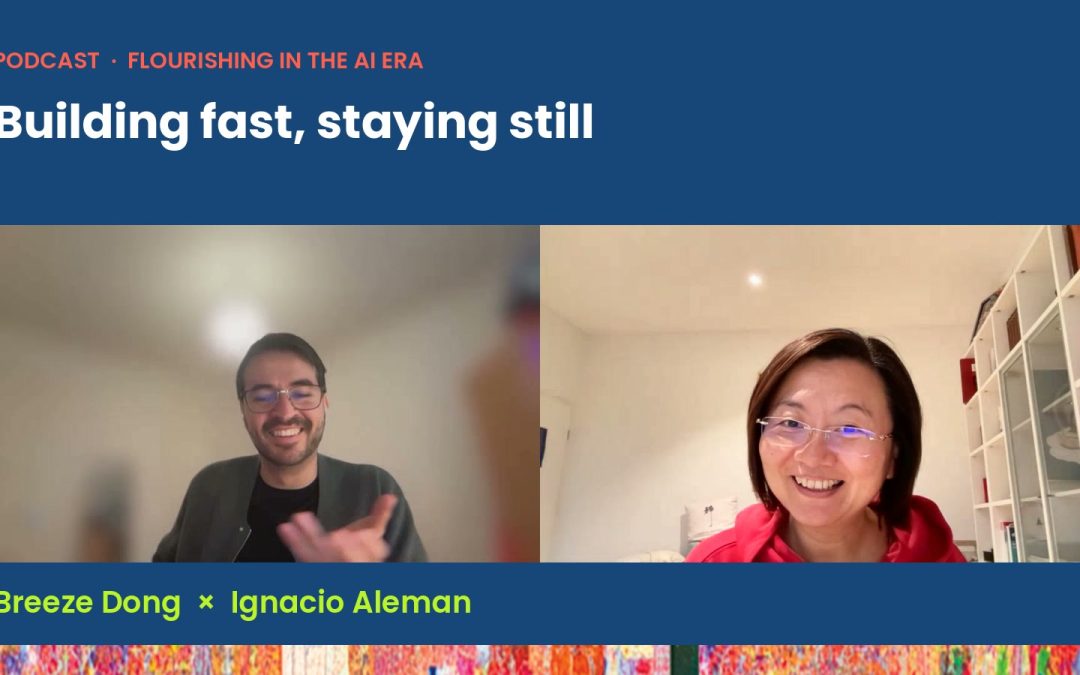
Watch the full conversation on YouTube.
“Now you can just never stop.”
Ignacio Aleman said it quietly, describing his own days of working with AI agents. It is the sentence that stayed with me most from our conversation, because I recognized myself in it.
Ignacio began in economics, moved into telecommunications and statistics, and has worked as an AI researcher and startup builder ever since, most recently building a product with AI at its core. We first met at a weekend meditation retreat, which may explain why our conversation kept moving between two worlds: agents that never tire, and the stillness that humans need.
How wrong even the experts were
I asked Ignacio what he has learned from being deep in the trenches. His answer surprised me with its humility:
“One of the big learnings was how wrong I was about my view of the world.”
He studied at one of the few places where people were seriously working on these models. Even there, he said, few professors expected such a leap from “something that could answer in a relatively coherent way” to what we can now call, in some sense, intelligence. There was no theory that promised bigger models would keep improving. It was found by experiment.
I found that comforting. If the people closest to the technology were surprised, the rest of us can forgive ourselves for feeling dizzy.
Who reviews the review?
I shared the story of a 63-year-old Chinese founder who redesigned his engineering company around AI and removed the middle-management layer that mostly relayed information. Ignacio offered a thoughtful counterpoint. Managers also help people focus, align and clear roadblocks, and that still needs human judgment.
He sees the same pattern in software. AI builds what you ask for, but the deeper you are in the work, the more you notice it doesn’t always do what you meant. You can have another AI check the first one.
“But who reviews the review?”
He told me how he used several AI models, in parallel and in rounds, to build his case against an unfair charge when he moved out of his flat. A lawyer checked the result and was impressed; it likely saved him a few hundred francs. Yet the lawyer’s eye still mattered. For me, the lesson is simple: when producing becomes almost free, knowing what good looks like becomes the real work.
Too much of a good thing
Ignacio named a shift that only became possible in the last year. You can now give an agent a task, wait a few minutes, and run ten tasks in parallel.
“Before, at some point you didn’t have the mental energy to start something new. Now you can just never stop. And too much of a good thing can be a bad thing.”
I first heard the phrase “AI brain fry” from Peng Wang, my co-author, who works in a very intense AI environment in China. When I asked whether he uses a personal agent on his phone, he said no. If an idea comes when he has no laptop, he simply doesn’t work on it in that moment. He is protecting his time.
I confessed my own pattern to Ignacio. Every time I create something with AI, I get a dopamine rush, and it comes again and again. At some point I have to ask: is this really healthy? Ignacio wondered whether there is something of social media’s reward hacking in it: learning and building used to have a natural pace, and AI is changing that pace.
The mass production of ideas
We then looked further ahead. Ignacio offered an image I keep returning to. A hundred years ago, industry learned to mass-produce cars and refrigerators.
“What AI is likely to enable is the mass production of ideas.”
He described a research team that gave a thousand agents a large mathematics task, made one of them the leader, and let them organize themselves. As a student of living organizations, I find that fascinating: self-organization, now among agents.
And yet the in-between stage is awkward. We can create so much. Who is reviewing it, and does it even make sense? I remembered typing on a black DOS screen at primary school, unable to imagine websites, apps or podcasts. We are probably at a similar beginning now.
Burying a talent
Transitions also carry grief. I told Ignacio about my first book, A Soulful Transition, and the bottom of the U: the place where we have let go of what has passed, but the new has not yet come to life.
I shared an essay by a senior engineer at DeepSeek that moved many readers in China. He wrote that he had to “bury his talent in yesterday”, because within a year or two AI would do his craft better than he does. He compared himself to a craftsman whose days of patient work a machine can now reproduce in minutes.
Ignacio recognized it. For software engineers, much of the work has moved from writing to reviewing:
“There’s this element of letting go: this is part of what I used to do, this very big component. And it’s changed.”
Not all work is made with love, he added. But where it is, the loss is real, much as we can still feel the difference between a bespoke shirt and a mass-produced one.
Coming back to stillness
This is where our two worlds met. I told Ignacio that the more I interact with AI, the more I reach a moment where something clicks and I need quietness, a detox from every screen. That Sunday I was going to a full-day silent Vipassana retreat, and I couldn’t wait.
Ignacio described his own cycles through his room: it starts clean and organized, he gets busy, things slip, and then he notices and returns. I laughed, because he was describing my mind.
The real world is bigger
At the end I asked for his advice to people like me who are not technical. Test new models when they come out, he said, but don’t get lost in the hype. And then:
“Don’t worry too much. The real world is very big compared to this digital world.”
Walk into a hospital, he said. It is full of machines, but it is still people moving things around and caring for people. The bridge between the digital and the physical world is far from solved.
A few threads I’m holding
-
Humility is a good starting point. Even the experts were surprised.
-
Judgment is the work. When producing is easy, know what good looks like.
-
Pace yourself on purpose. Agents don’t get tired. We do, and that is wise.
-
Return to stillness. Quiet is where the creative spark becomes audible.
When AI never stops, what helps you come back to stillness?
The full conversation is in the video above, with subtitles. You can also listen to it as Episode 7 of Flourishing in the AI Era. I’d love to hear how you pace yourself.
Breeze Dong is the author of The Living Organization and writes AI-Native, Deeply Human. Ignacio Aleman is an AI researcher and startup builder based in Lausanne. His views are his own.
Chunfeng “Breeze” Dong is an organizational development leader and executive coach (ICF PCC, CPCC) working on AI-native organization design. She has spent over twenty years in global enterprises, from strategy at Roland Berger to organizational development at Siemens, ABB and Roche. She is the author of A Soulful Transition and co-author, with Peng Wang, of The Living Organization. More: AI-native organization design · LinkedIn · Substack