🎧 Prefer to listen? The full narration of this essay is free — listen here.
Prefer to read? The full case follows.
Most companies add a management layer when coordination gets hard. Block deleted four of them and posted its best results ever.
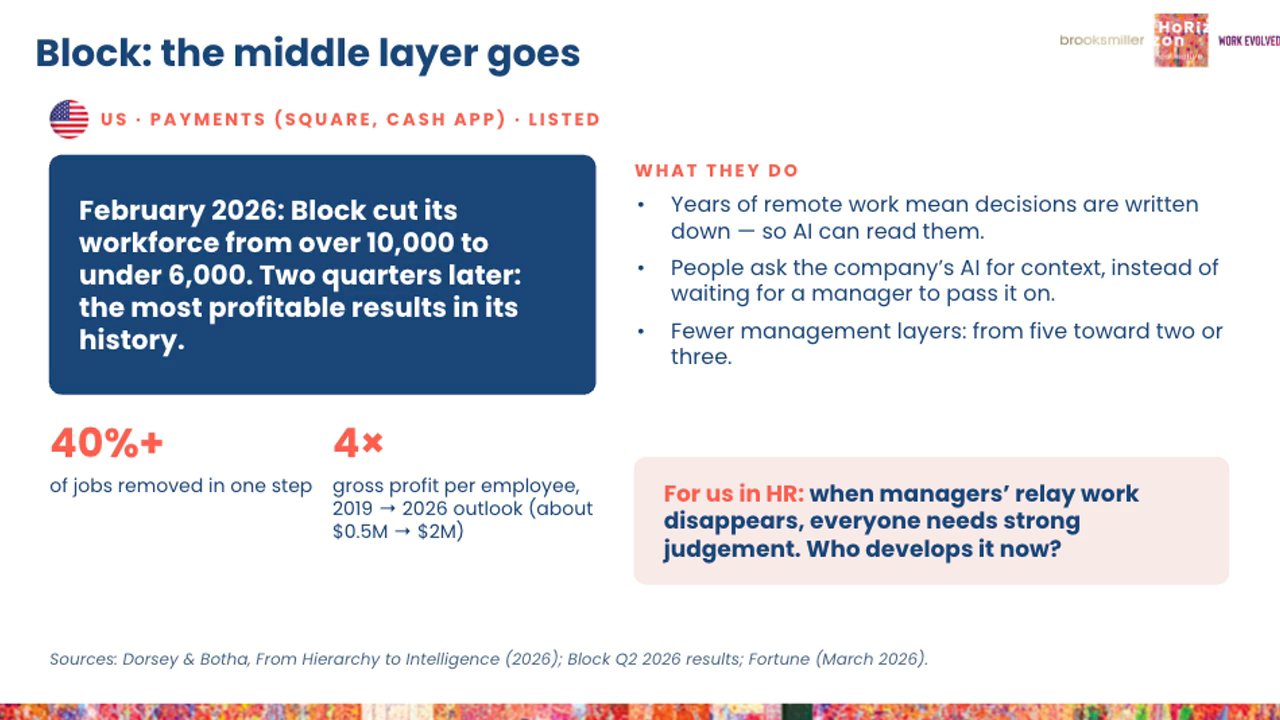
On 26 February 2026, Block — the company behind Square, Cash App and Afterpay — announced it would cut its workforce from more than 10,000 people to just under 6,000.
The numbers first — because they earn the right to the argument
Block tracks one number above all: gross profit per employee. It sat at about $500,000 in 2019 and barely moved as headcount grew to roughly 13,000. Then $750,000 in 2024. One million in 2025. And about $2 million if the 2026 outlook holds.
The first quarter after the cut carried roughly $495 million in restructuring charges — and gross profit still rose 27 percent. In the second quarter gross profit reached $3.17 billion, up 25 percent, with a record $864 million in adjusted operating income.
Underneath sits software. Block’s coding agent, goose, has run in production for about eighteen months. The company reports developer productivity up 40 percent per engineer, code changes up 150 percent since the start of 2026, and Square shipping 130 features in the first half of 2026 — three times as many as a year earlier.
Impressive. Also not the point.
The point is what hierarchy was for
This is an org-design move wearing a technology costume. Command-and-control was never a moral preference. It was an efficient answer to expensive information. Every layer and every approval chain is machinery for routing scarce information to scarce judgement.
That is the Adaptation Gap in its purest form — a jet engine strapped to a horse-drawn carriage. Jack Dorsey and Roelof Botha of Sequoia made the same case in their essay From Hierarchy to Intelligence. Many companies had tried to escape hierarchy, they wrote, and nearly all fell back — not because flat was a bad idea, but because nothing replaced what hierarchy actually does.
That framing matters, because it removes the moral charge. Hierarchy was never the villain; it was a solution with a price, and every layer buys coordination by paying in latency. My book makes the same argument from the other side: the machinery was rational when information was expensive, and stops being rational when information is free. So Block and this book agree on the diagnosis. The case is about whether we agree on the cure.
And here is the mechanism, stated plainly
Block has worked remote-first for years, so decisions, code and discussions already exist as text. That is what makes them readable by a machine. Two “world models” now hold what managers used to relay. One maps the company. The other maps each customer’s and seller’s financial reality from transaction data.
That remote-first history is the quiet precondition almost everyone misses. Most organisations could not copy this, because their decisions live in meetings rather than in text. Block’s habit of writing things down handed it a machine-readable company.
The coordination work said to consume around 80 percent of a middle manager’s time — gathering, tracking, aligning — is handed to the model. Frontline employees no longer need a manager to relay context. They ask the model, and they decide.
And here is the discipline worth copying
In July, Block launched Buzz, a workspace where every AI agent has its own identity, keys and audit trail, tied to a named responsible person. That is Human–Agent Governance done properly. Not a policy document, but an org chart for machines — the American cousin of Lenovo’s named owner.
Read the shape of it, though. At launch, a technical review found, all activity routed through a single authoritative relay: one server that authenticates everyone, stores every event and triggers every automation. Peer-to-peer replication was not part of the design, and approval gates for agent workflows were unfinished. Network designers call that a star — the fewest layers, and the most centralised structure possible.
That gives the case its mechanism. The Star-Topology Problem: removing management layers does not by itself distribute authority. Where the layers are replaced by a single hub — one leader, plus one model everyone consults — the organisation becomes flatter on the chart and more centralised in fact. Flatness is a property of the drawing. Distribution is a property of who may decide.
Which relocates that risk rather than abolishing it. Any distributed-authority model that does not not structurally remove the middle’s monopoly on information drifts back toward hierarchy. Block removed the middle managers completely. The question is whether it abolished that monopoly or moved it into the world model. Whoever decides what the model contains, how it summarises and which questions it answers now holds the power the middle layer used to hold, with less friction and less visibility. The model becomes the new middle.
The hard part is what happens to judgement
With two or three layers, everyone who remains has to exercise strong independent judgement. The people who used to coach that judgement were often the managers who left.
Judgement here is not a personality trait. It is the ability to decide with incomplete information, to notice when the model is confidently wrong, and to carry the consequence of the call. Removing information routing does not remove the need for it; it moves the whole bill to the front line.
A heuristic from China’s intelligence-density community makes the trade-off visible: effective intelligence equals human intelligence multiplied by artificial intelligence, multiplied by the ease of connecting across systems. The multiplication sign is the point — addition would imply a division of labour with outputs summed, while multiplication implies coupling: if any factor falls toward zero, so does the product. Put Haier and Block side by side and they are mirror images. Haier spent twenty years building frontline judgement and is still climbing on AI. Block built AI from the information architecture up and is assuming the judgement. Haier built the capability before it removed the layers. Block is attempting it in the other order. That is the real experiment, and it is the one the profit figures cannot score yet.
The uncomfortable half
Here is the fork. Lenovo and Haier say they redeployed the capacity AI freed. Block removed it. Same tools, same diagnosis, opposite answer — and so far both roads pay.
That is exactly why this is a values decision rather than an efficiency calculation. Gross profit per employee rises whether the business grows or the headcount shrinks. The metric cannot tell those two apart. Only a leader can.
Two cautions keep this honest. Block’s strong quarters also reflect lending growth and product launches, so causation is unclear, and two quarters is short — the real test is whether coordination roles quietly grow back under other names. And Block may yet show that its remaining six thousand people are more autonomous than before; if it does, the story gets rewritten. But no evidence changes one thing: what happens to the people whose coordination work disappears is decided by leaders, not by technology.
Design the machine to be AI-first, so that the people can be more human.
One question to hold this week: if you removed a layer of management tomorrow, who would hold the information it held?
Sources: Jack Dorsey and Roelof Botha, From Hierarchy to Intelligence (Sequoia, 2026); Block Form 10-Q and the Q2 2026 shareholder letter and earnings call (August 2026); Fortune (6 and 21 March 2026); CNBC (February 2026); reporting and technical reviews of Buzz (July 2026). Framework reference: Chunfeng “Breeze” Dong and Peng Wang, The Living Organization — the AI-Enabled Living System, its five pillars, the Star-Topology Problem and the Adaptation Gap. Figures are company-reported. No affiliation with Block.
Mirrored from AI-Native, Deeply Human, the newsletter by Chunfeng “Breeze” Dong. Get new essays by email.