🎧 Prefer to listen? The full narration of this essay is free — listen here.
I did not fly to Hangzhou this year. I joined the AI Native Organization Forum at Alibaba’s Apsara Conference the way most of us now attend the things that matter — online, from my desk in Switzerland, notebook open and the sound turned up.
It ran for an afternoon. I filled several pages.
This note shares what I wrote down. It was Alibaba’s fourth consecutive organization forum, and for the first time it was co-hosted by the CPO line and the CIO line — the people who run the organization and the people who run the business systems, on one stage. Jiang Fang, Alibaba Group’s Chief People Officer, opened with the reason: “Business systems are being rewritten by AI, and organizations will inevitably be rewritten too. For the first time, the people who run the business systems and the people who run the organization are sitting down together.”
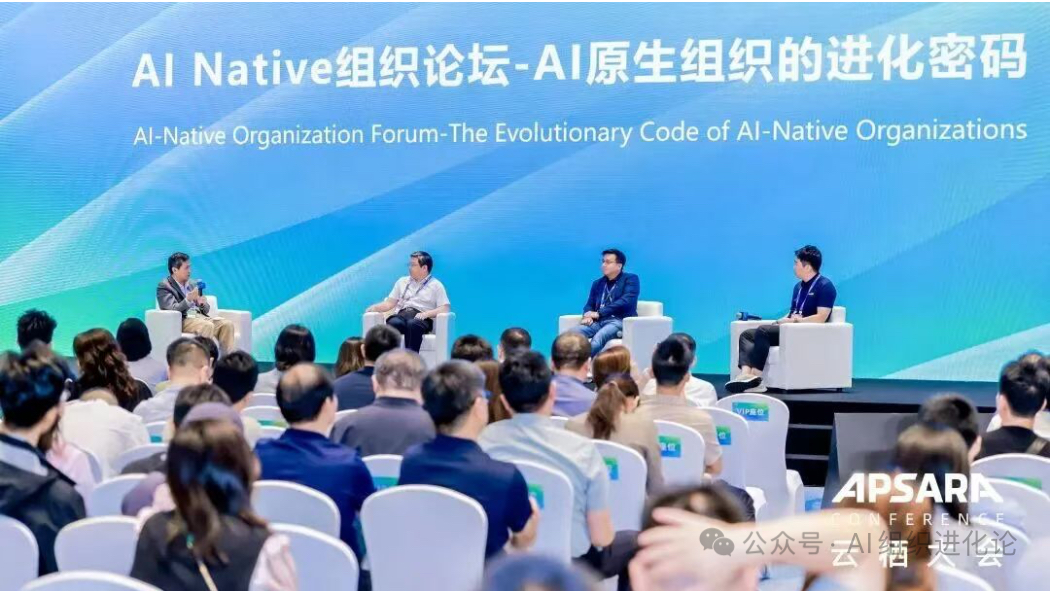
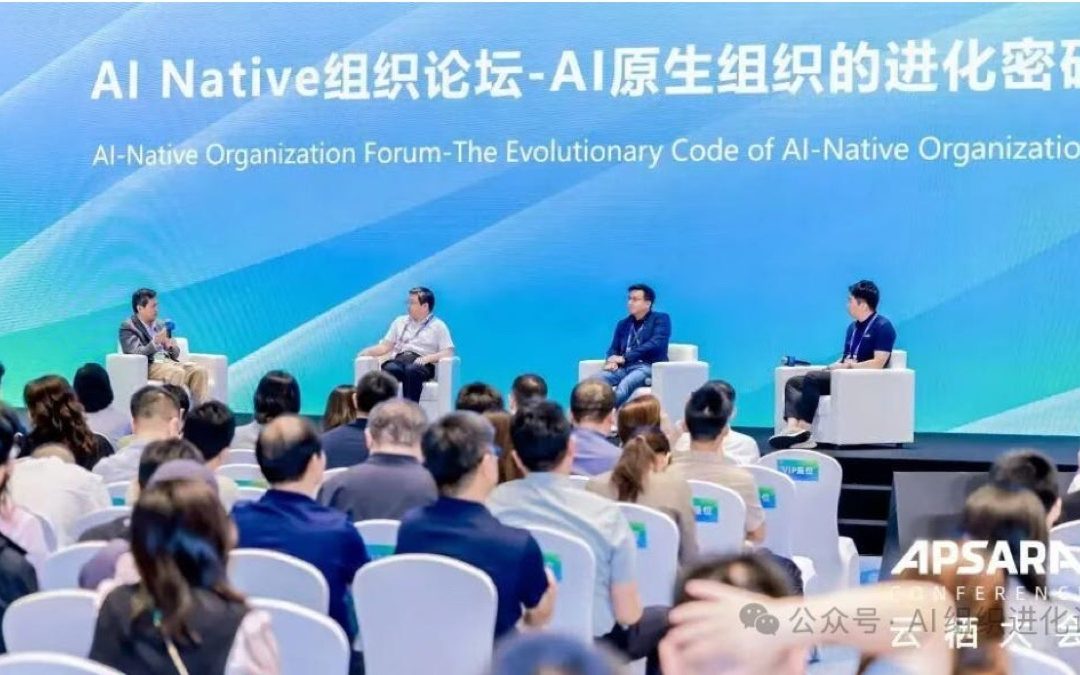
The AI Native Organization Forum at the 2026 Apsara Conference in Hangzhou, where Alibaba’s CPO line and CIO line shared a stage for the first time. Photo: AI组织进化论
The detail that stayed with me was not a product announcement. It was the seating.
My co-author Peng Wang and I argue in The Living Organization that this is the whole question. The book proposes the AI-Enabled Living System: AI absorbs coordination and processing, humans hold judgement, meaning and direction. It rests on five pillars.
Watching from my desk, what struck me is that Alibaba did not present a framework. They presented evidence. Laid across those five pillars, they are already standing — under different names, on the other side of the world. These are my notes, in order.
First, the gap — and they measured it
The book opens with a feeling most executives recognise and few can quantify. I call it the adaptation gap: the widening distance between what technology makes possible and what our organizations, designed for a different century, can absorb. My image for it is a jet engine strapped to a horse-drawn carriage.
Alibaba put a number on it.
Jiang Linquan, Alibaba Cloud’s CIO, described what happened after his team adopted AI coding tools heavily. AI-generated code climbed steadily. The end-to-end time to deliver a real requirement did not come down. So he did the arithmetic out loud. A developer spends about 20% of working hours writing code; the other 80% goes into requirement communication, confirmation, testing, release and operations. Of that 20%, core and complex code is a fifth.
So if nothing else in the chain changes, AI can only touch roughly 7% of end-to-end elapsed time.
Seven percent. That is the adaptation gap in decimal form. I underlined it twice. Jiang Fang’s own line was blunter: “An increase in individual productivity does not necessarily produce a leap in organizational efficiency.” Note the second cost, too: AI-generated code arrives faster than anyone can verify it, so the strongest engineers get buried in checking work.
Her image for the underlying mistake is almost identical to mine. Grafting AI tools onto the old process is like fitting a steam engine to a waterwheel. The power source changes. The transmission does not. The transmission is the operating model.
Pillar One — Distributed Authority: they moved the decision rights, not the licences
The first pillar is distributed authority: decisions move to the edge, where the work meets the world, so ideas stop dying from diffusion and start converting into motion.
My test for “AI-native” is not whether an organization bought AI. It is whether AI changed the org chart and the decision rights, or only the software licences. Alibaba’s CIO line passed twice.
First, the roles. Using a Half-stack concept, Jiang Linquan’s product-and-engineering organisation collapsed multiple specialised roles into two. On the customer side, product management, design and frontend merged into a PDFE role responsible from user intent to user interface architecture. On the engineering side, backend and architecture merged into an ABE role responsible from data structure to system stability. The two connect through API contracts. Eight roles became two.
Second, and more telling, the CIO’s own job inverted. Requirements used to be centralised to the CIO team and queued. Now business teams close the loop on simple, vertical needs themselves, while the CIO handles only complex, cross-domain work. A new role appeared — “developer operations” — one assigned to each business team, treating the business as a new developer rather than a queue of tickets.
That is distributed authority written into a job description. It is also the honest answer to why the 80% exists: coordination is expensive precisely when authority sits far from the work.
Pillar Two — Fluid Structure: special zones, not cascades
The second pillar is fluid structure: teams form around problems, not org charts. Structure becomes something the organization does, not something it has.
Alibaba’s version is the special zone (特区). Jiang Fang was blunt: “Let special zones experiment first. Don’t expect everyone to march in step.” Her image for the alternative is renovating an old city — you do not wait until every condition is ready.
Five people built QoderWork in seven days. The plan was discussed, decided and revised the same day, with no elaborate approvals and no cross-departmental negotiation. Something the industry normally needs months to validate ran a full loop in a week, because problem, decision and revision all stayed inside one short decision chain.
Then a larger instance: a 100-day AI maker competition from February 2026, in which everyone submitted, the work did not have to relate to anyone’s job, and token consumption was deliberately never a forced metric. Finalists included a family companion robot dog and an AI video platform built by a management trainee born in the 2000s.
Structure that forms around a problem and dissolves when it is solved. That is what a living system does. Galbot’s roundtable contribution named the mechanism exactly: emerge, filter, replicate. And An Xiaopeng, moderating, gave the structural claim the book is built on — the most basic unit of the organization is expanding from person-to-person to person-and-digital-employee.
Pillar Three — Evolutionary Purpose: one objective function
The third pillar is evolutionary purpose: a shared “why” strong enough to coordinate a thousand decisions without dictating any of them.
Yuan Yimin, HR Vice President for Alibaba Cloud’s international business, described the mechanics better than any management book I have read. She proposed starting with a single objective function. Online advertising, offline events and market intelligence each used to carry their own KPI. Every local metric was met, and it was impossible to say how much business the leads actually produced. So they made all of them point at one thing: Leads conversion ROI. Task routing is then adjusted according to real contribution.
Her sentence deserves quoting: the division of labour is no longer written only into job descriptions; it changes with the results data.
That is the link between pillars one and three: distributed authority is only safe when everyone steers by the same star. Alibaba could push decisions to the edge because it had collapsed a dozen departmental goals into one. Purpose here is not a poster; it is the mechanism that lets the hierarchy thin out.
Pillar Four — Human Wholeness: protecting attention
The fourth pillar is human wholeness: whole human beings, developed enough to exercise the judgement that distributed decisions require.
Yuan Yimin used a set of numbers for decision cost: five people in a review generate 10 communication links; fifteen generate 105. The most expensive hidden cost inside an organization, she said, is attention. Her remedy: layer decisions by scenario, compress the management view, drill into full context only when necessary.
Read that against the 7% figure. The point of the redesign is to buy back human attention and spend it on judgement machines cannot supply.
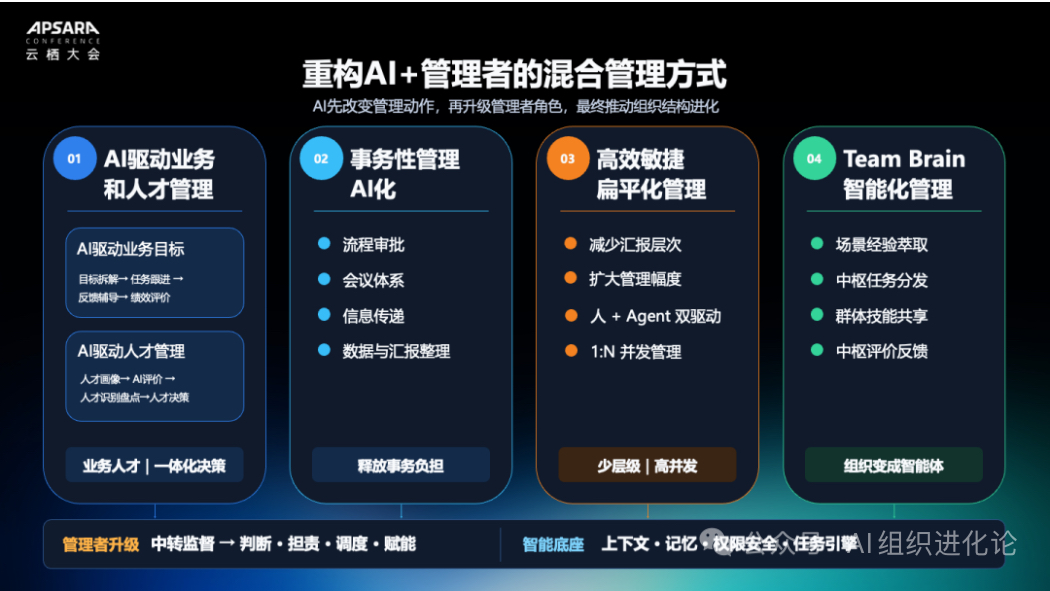
The forum’s map of hybrid management. Transactional management moves to AI; flattening reduces reporting layers; and the manager’s job shifts from relaying and supervising to judging, owning, scheduling and enabling — with context, memory, permissions and a task engine underneath. Photo: AI组织进化论
Bao Chenxing, HR Vice President at Alibaba Cloud, showed what that looks like in practice. He uses an AI-prepared draft for quarterly feedback to more than twenty people, then reviews and confirms it himself. Colleagues told him it was the best feedback they had received at the company — because it carried specific data rather than two sentences. His formulation is the cleanest statement of the pillar I have heard from a practitioner: AI expands the coverage of information; the manager calibrates judgement, sets boundaries, and owns the result. The span can expand. Evaluation cannot be handed to a black box.
Then the line the forum turns on. Jiang Fang named what she hires for: “Talented but small ego.” In the coming year, human colleagues will work alongside digital colleagues — and the digital colleagues have no ego. It is the humans who must learn to share context, release part of their control, and help the digital colleague do better work. That is not a soft skill. It is the load-bearing wall of the design.
Pillar Five — Human–Agent Governance: the pillar with no precedent
The fifth pillar has no precedent, and it is where Alibaba’s account runs ahead of most Western practice: human–agent governance — deciding and enforcing what agents may do autonomously, what requires human review, and what stays human-only. In the book, the leadership tool for this is the Machine Governance Matrix.
Alibaba did not present a matrix. They presented rules, tested in production.
Jiang Linquan’s openness principle is a governance decision stated in one line: when an agent acts on someone’s behalf, it must inherit the employee’s original permissions. No new authority, no shadow identity.
He also named the failure mode the matrix exists to prevent. A general-purpose agent will open browsers by itself, retry at high frequency, consume tokens at speed, and “blow up” the company’s business systems. Over four months, calls from general-purpose agents to his business systems grew 1000-fold, surpassing GUI interaction and first-party agents. That is what happens when you open the doors before you write the rules.
Lanzhou Petrochemical is the pillar in full. An anomaly-diagnosis agent was connected to a 5.5-million-tonne atmospheric and vacuum distillation unit. A real alarm came in the same day, and on-site experts judged its root-cause analysis close to that of an engineer with five years of experience. To get it there, the team built more than ten thousand entity nodes and twenty thousand ontology relations, and configured permissions, verifiable loops, execution boundaries, a human final decision, and full-process observation.
It was built in 45 days instead of six to eight months. The cycle shrank. The safety standard did not.
That is the whole argument for governance-first design. AI carries the load; humans carry the meaning — and in a refinery, the meaning includes who is accountable when the alarm is real.
What the pillars look like when they hold: forward deployment
Our tenth chapter, led by Peng Wang, is about getting from demo to production. Hangzhou supplied two examples I will be citing for years.
A short-drama platform hired five outsourced people for two months; the result was still unsatisfactory. One TAM technical service engineer rebuilt the production platform in two weeks, re-orchestrating the models and video tools himself.
Better still: a salesperson with a humanities background and no coding experience was told on Friday that the client’s CTO wanted a training-platform proposal by Monday. Two days later he delivered a working demo — a host practising in a simulated livestream room while AI evaluates, gives feedback and scores. The client asked to build the product around it.
Neither is a tooling story. Both are org stories: a person with authority, close to the problem, inside a short decision chain.
What Alibaba has not solved — and neither have we
I will not turn this into a victory lap. Alibaba was explicit about what remains open. By Bao Chenxing’s own three-stage model — tools in individual work, then humans and agents as a mixed network, then an AI organizational brain — Alibaba Cloud is still in stage two, with roughly 600 digital employees. Stage three remains a goal.
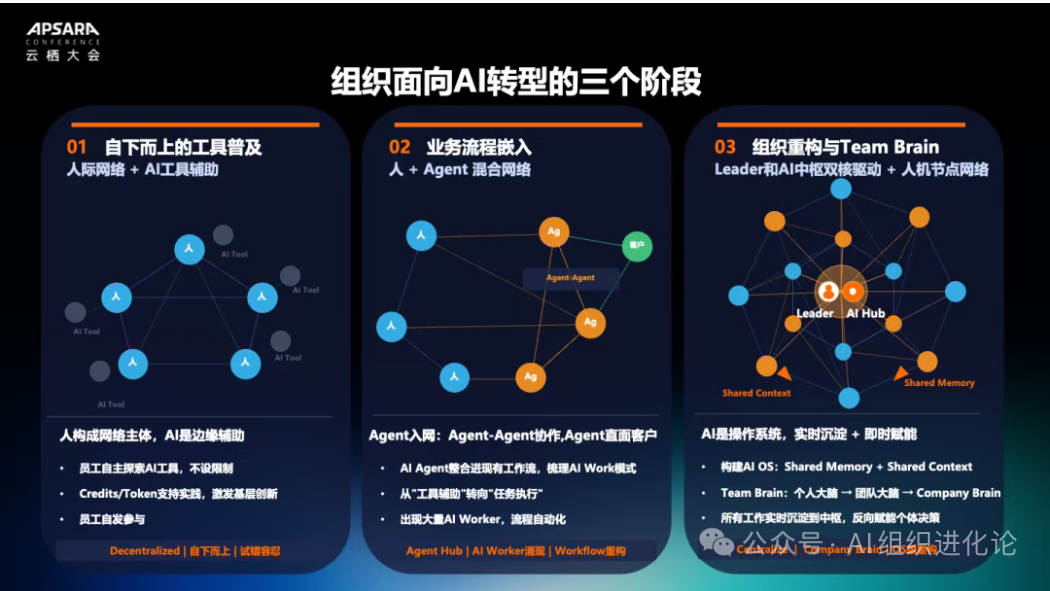
Bao Chenxing’s three stages of organizational AI transformation: bottom-up tool adoption with AI as an edge assistant; agents entering the workflow as colleagues; then the organization rebuilt around a Team Brain where shared context and shared memory settle in real time. Alibaba Cloud places itself in stage two. Photo: AI组织进化论
The roundtable named the unresolved questions plainly: how high-risk industries handle model uncertainty; who owns agent permissions and auditing; and whether a forward-deployed engineer is priced by project, by token, or by business outcome.
The sharpest test of whether any of this is real came from Ruan Zhongyou, CIO of Yihai Kerry Arawana: “The colleagues who really understand AI are now cancelling weekly meetings and weekly reports. The colleagues who don’t understand AI are busy holding AI transformation meetings.”
That is the test I would apply to any leadership team. Not the strategy deck. The calendar.
The pillars were already standing
What matters is not that Alibaba validated a book. It is that the pillars were already standing, inside a company of Alibaba’s size, eight thousand kilometres from where I wrote them down — reached from a different starting point, under different constraints.
That is what a living system looks like when it works. You do not have to install it. You have to stop preventing it.
Alibaba’s three-part answer — leaders get in the water first, small zones move first, the workflow gets rebuilt — is not a technology roadmap. It is org design. And Jiang Fang’s closing words are the most honest thing I have heard from a CPO this year: “Nobody has the answer. All we can do is throw ourselves fully into this exploration.”
I closed the laptop at the end of the afternoon with more questions than I started with, which is usually the sign that something was worth attending.
Technology removed the constraint. Philosophy decides the outcome. The five pillars, the Adaptation Gap Assessment, the Cultural Carriers Method and the Machine Governance Matrix are all in The Living Organization.
What I keep circling: design the machine to be AI-first, so that the people can be more human.
— Breeze
Sources
The AI Native Organization Forum took place at the 2026 Apsara Conference in Hangzhou on 22 September 2026; I attended online from Switzerland. The account I worked from is the Chinese write-up by the WeChat account AI组织进化论 (AI Organization Evolution): 阿里最新AI原生组织实践:管理者先下水、特区打头阵、重构工作流, published 29 September 2026. All speakers, figures and quotations above are drawn from that account; where I quote in English, the translation is mine.
Framework reference: Chunfeng “Breeze” Dong and Peng Wang, The Living Organization: The New Operating Model for Flourishing in the AI-Native Era — the AI-Enabled Living System, its five pillars, the Adaptation Gap Assessment, the Cultural Carriers Method and the Machine Governance Matrix.
Speakers referenced: Jiang Fang (蒋芳), Chief People Officer, Alibaba Group · Jiang Linquan (蒋林泉), Vice President and CIO, Alibaba Cloud Intelligence Group · Bao Chenxing (包晨星) and Yuan Yimin (袁亦敏), HR Vice Presidents, Alibaba Cloud Intelligence Group · An Xiaopeng (安筱鹏), Vice President, Public Affairs, Alibaba Cloud Intelligence Group · Ruan Zhongyou (阮忠友), CIO, Yihai Kerry Arawana.
Chunfeng “Breeze” Dong is an executive coach (ICF PCC, CPCC) and founder of Springbreeze Ventures, with over twenty years in global enterprises, from strategy at Roland Berger to organisational development at Siemens, ABB and Roche. She writes on AI-native organisation design, human–agent governance and change leadership. She is the co-author, with Peng Wang, of The Living Organization.
📘 The Living Organization · 📘 A Soulful Transition · 🔗 LinkedIn
Mirrored from AI-Native, Deeply Human, the newsletter by Chunfeng “Breeze” Dong. Get new essays by email.