
🎧 Prefer to listen? The full narration of this essay is available to paid members — listen here.
Inspired by the many responses of the article I shared on Applying Systemic Approaches in Large Organizations, and especially much curiosity of the pain points along the journey, I’d like to share a bit more on reflections of one key systemic pain point — collaborative overload and the importance of fostering holistic well-being.
In more detail, this article in a case study format shares experience of pulse sensing with close to 400 colleagues contributing to many self-organized teams; insights addressing individual, team and organizational level interventions to tackle collaborative overload. Moving forward, the importance of fostering holistic well being in the world of fluid and collaborative team work.
The context
This case study is an organization that operates in complex healthcare ecosystems across more than 89 countries. The vision is to double patient benefits with less societal cost and achieve this goal by adopting new radical approaches to work across multiple therapeutic areas and decentralized markets. This requires increased collaboration and a more networked approach that enables the fluid transfer of talents and expertise across markets and therapeutic areas. We assume that fostering people fluidity will enable more seamless cross-border collaboration and ultimately help achieve its goal.
As a consequence of increased people fluidity, employees are required to collaborate with more internal and external contacts than ever before due to the increased complexity of organizations and products. This has resulted in less time for focused individual work and decision making.
Furthermore, research shows that collaborative demand has risen 50% or more over the past decade to consume 85% or more of most people’s work weeks.This trend has intensified due to the hybrid work model during the pandemic, prompting risk of overload and deterioration of productivity and well being.
Lack of transparency or awareness in the workplace can have severe negative impacts on our physical and mental well-being, leading to high levels of stress. This is supported by research conducted by Prof Rob Cross, which reveals that individuals who are at the center of collaborative efforts are often the most demanded yet least engaged. This can result in burnout, career derailment, and a decline in overall workplace morale. It is crucial to recognize the detrimental effects of poor workplace transparency and actively work towards fostering a culture of openness, trust, and communication. By doing so, we can create a more supportive and sustainable work environment that promotes employee well-being and leads to better outcomes for individuals and the organization as a whole.
Fortunately, many organizations are taking proactive steps to address these challenges by utilizing organizational network analysis (ONA) to protect employees from collaborative overload. In this case study, we conducted an ONA and initiated experiments to learn from central collaborators and address critical issues affecting productivity. One of the recurring challenges we identified was collaborative overload, which we’ve been working to tackle by surveying colleagues involved in multiple work packages to gain deeper insights. Our goal is to create a supportive work environment where everyone can thrive and contribute their best.

Insights from the survey
Close to 400 colleagues who collaborate in self organized work packages(WP) responded to the Tackling Collaborative Overload survey (less than 20% of whom collaborate in 3 or more WPs, the rest collaborate in 1–2 WPs)
Overall more than 2/3 of all participants report that collaborative overload is a pain point.
Majority of all participants have the intention of improving collaboration, including better prioritization (75%); block time for learning and reflection (90%), contributing to work that brings better overall well-being (85%). Over 75% of all participants have the desire to be more comfortable saying “no” to incoming requests.
Overall survey results indicate causes for collaborative overload may come from compounded factors, not single one factor: e.g, when taking social factors into account, data shows social and relationship factors driving collaborative overload as majority of the participants (90%) answer requests of help from close colleagues. Additionally, transparency is another factor because you can’t improve what you can’t see. 85% of participants indicate that work packages take longer than expected to complete. Time estimation and commitment is hard to improve when there is no visibility about it. 70% of participants have low or no clarity about the time they spend in work packages.
To tackle that, visible individual and collective boundaries and clarity may help counter collaborative overload.
We see from the survey that the majority (>75%) see opportunities to improve what to prioritize and clear transparency on the priorities. Two additional boundaries for collaboration could also help to counterbalance the load:
-
Collaborating only when role and contribution is clear could benefit 62% of participants
-
Limiting the amount of initiatives in progress could benefit 64% of the participants
Learnings from external research and experience
External research also provides insights on fostering collaboration but avoiding collaborative overload.
-
Provide time and space to collaborate and reflect
-
Structure work based on expertise and goals
-
Leverage formal/informal roles to support collaboration
-
Give freedom to shift work
For individuals, research from i4cp found out that we can buy back 18–24% of our collaborative time by:
Imposing structure — Orient to our North Star objectives and shape role interdependencies
Challenging Beliefs — Address our identity and ‘fear’ drivers
Altering Behaviors — Create channel efficiency and streamline norms
In addition, experiments from General Mills show that, in order to be more conscious in managing our time, focused attention is critical. External benchmark confirms than 2 hrs per week of focused work and reflection increases the wellbeing and sense of engagement of employees by 50%
Areas of intervention
During a deep dive analysis, we uncovered several themes that could address collaborative overload:
-
Clarity of outcomes;
-
transparency and visibility of project work;
-
sharing & learning good practices of collaboration,
-
empowerment and autonomy;
-
motivation and appreciation,
-
understanding individual and team capacity.
These themes provide insights that help to tackle overload from individual, team and organizational levels. It is clear that collaborative overload is not a linear problem, it is a complex one. Clarity of outcomes, transparency and visibility of project work contribute proportionally more to tackling collaborative overload than other themes identified.
To address the overload issue, we need to work on the mindset, awareness on the individual side, as well as transparency, clarity on the team and organization side, and tools and platforms from the organization side. Such a systemic approach is essential for solving collaborative overload challenges.
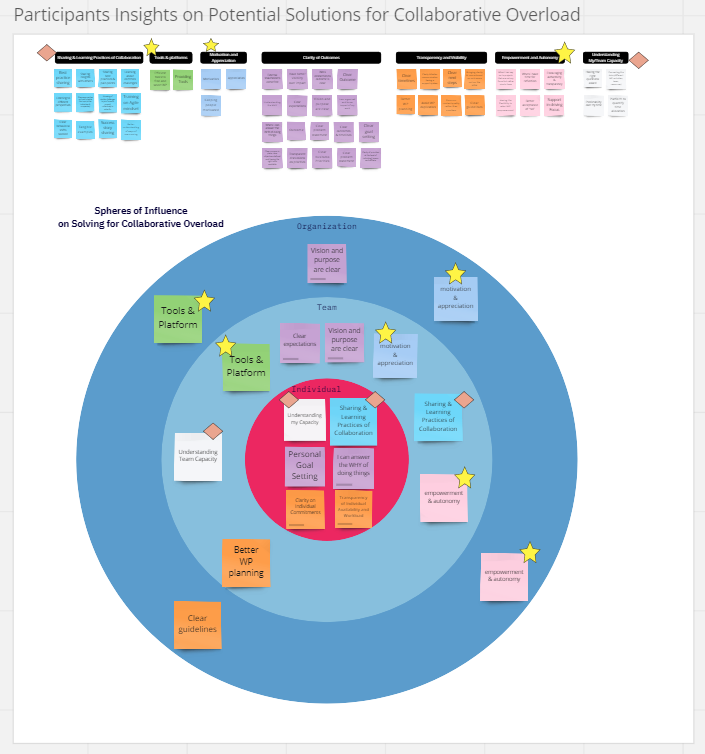
Going forward- the importance of holistic well being
To foster the future-fit work environment, tackling systemic pain points is only part of the story. We are also conscious of the importance of well-being.
It’s heartening to know that research has discovered the profound advantages of nurturing well-being within organizations. By placing a greater emphasis on well being, we can cultivate a workplace environment that is more enjoyable and fulfilling. When we prioritize the mental and physical well being of our people, we not only create a better workplace, but we also foster a sense of belonging and community that can positively impact every aspect of our lives.
The learnings of collaborative overload gave us a reminder that awareness and clarity of systemic pain points is a starting point to work towards the collective thriving of colleagues. To elevate collective thriving, we took the perspective of both the individual and systemic (team and organizational) side.
From the individual perspective
We collaborate with Wisdom Works using their framework of Be Well Lead Well. This is a framework that helps build capabilities to advance human thriving. It integrates 6 dimensions of thriving
THRIVING: Evaluate your overall wellbeing today and in the future, as well as your ability to restore your wellbeing when you face difficulties or get off track.
FUEL: Proactively use your diet, physical movement, breath, and rest as tools for a sustained, balanced source of physical, emotional, and mental energy.
FLOW: Be in the zone — those times when you bring mindfulness and your full presence to the activities of life and work. You are intrinsically rewarded with energy, enjoyment, and a richer sense of how life unfolds with effortlessness and ease.
WONDER: Evolve worldviews through engaging in new experiences and challenges, embracing differences, and perceiving the beauty around you.
WISDOM: Tap into your inner greatness — the worthwhile purpose, higher vision, and innate genius you can use to guide yourself and others toward inspired impact.
THRIVING AMPLIFIED™: Bring forth more of your leadership potential to energize people, maximize their growth and capabilities, and cultivate a work environment of care.
From the perspective of teams and organizational level
It is important to address transparency, clarity of outcomes and impact on the team and organizational side, as well as tools and platforms that enable efficient resource allocation and communication.
Beyond that, we also integrated the Thriving Amplified dimension in a leadership development experience, aiming at bringing leaders along the journey to catalyze and enable collective thriving.
From the systems level, the journey is still ongoing. We also recognize that this is an area where we need more understanding and signals about progress.
Going forward, we continue to take a systemic approach, sensing the organization and respond to the most emerging needs. What is most inspiring and encouraging is the wisdom shared by people who thrive at their work. Reminds me of the quote “The future is already here, it’s just not evenly distributed.” We will amplify the wisdom from people who are thriving in the organization, aspiring to create conditions for collective thriving.
For additional insights on various other aspects of the journey, check out the following articles
The Concrete Benefits of Social Collaborative Learning
Stop Looking for Meaning from Your Manager
Mirrored from AI-Native, Deeply Human, the newsletter by Chunfeng “Breeze” Dong. Get new essays by email.